Showing posts with label county highpoints. Show all posts

Sunday, December 1, 2013

Comers Rock - Earning Your Views


There are often days when I am not especially motivated to go hiking, but feel like I should get out in the woods for a few hours anyway. These same days, I usually don't want to be gone all day, nor do I want to drive very far - generally no farther than thirty minutes away. While I’m lucky enough that there are a few very nice destinations that close to home, that distance nevertheless really limits the choices, and while a lot of the hikes that close are pleasant enough, most are little more than a walk in the woods. There just aren't very many spectacular destinations really close by. Some may be nice enough otherwise, but lack appeal because there is also a road to or near the final destination. That usually takes away any feeling of remoteness out wildness, and usually makes one question why they are hiking up, when they may well encounter hordes of people who drove up. And while I myself am not averse to driving up certain peaks on occasion, it’s rarely as rewarding as a good hike to the same place.

Such is the case with Comers Rock. One can drive to within a hundred yards or so of the top, a fact that often makes me discount it as a "serious" hiking goal. But I always forget just how good views actually are from up there on a clear day, and they are even better when you earn them by hiking up. And despite the proximity of a road, there are no"hordes". Besides, it's a pleasant hike anyway, if the chosen route is through the Little Dry Run Wilderness located to the north of the mountain. For the best part of the first three miles, this trail follows the namesake creek of the Wilderness (a rather grandiose term for this little 2,858 acre parcel), a tiny little stream with gorgeous hemlock lined banks, and small pools and undercut banks that harbor native brook trout, some of the prettiest freshwater fish there are. Finding their haunts was one of the original motivations for my interest in hiking. Though I don't fish for brookies any more, I still love visiting the beautiful places they live.


Tommy Bell along Little Dry Run. While not from this particular hike, it shows how pretty the area is.
The hike starts with an unbridged crossing of Dry Run. If the creek is low enough to rockhop here, then the rest of the hike is probably not an issue. If it’s really high, you might want to come back another day. The trail follows Dry Run upstream a very short distance, then sidehills back to the North and West to reach Little Dry Run. It crosses this smaller stream numerous times, and is a bit vague in a few spots, but as long as the creek is near, so is the trail until one reaches the uppermost headwaters - and if one avoids the trailless northern tributary at the 1.4 mile mark. On another note, it was near this spot a few years ago that I turned off the trail to climb Peak 3,300, the last summit I needed to have climbed all of Wythe County's 43 ranked peaks. That adds another element to my fondness of this area. As the stream dwindles to a trickle, the trail steepens and climbs to a broad saddle to intersect the Virginia Highlands Trail. This makes an appealing return route by following it back to the highway, but the way to the top avoids it and continues straight across, onward and upward from this divide that separates Little Dry Run from Jones Creek. While it is never really steep, the remaining mile-and-a-half is decidedly uphill. Very close to the end, after all one’s work to get here, the trail disappointingly deposits one onto the gravel Forest Service road going to the same place. However, after only a hundred yards, it ends and a set of rustic stone stairs lead the remaining steps.  At least the final 150 yards is foot travel only, so there is some solace in knowing that even if you share the summit with other people, you don’t have to share it with their vehicles as well. And you know they didn’t see the pretty places you were privileged to see on the way up. As it turned out on this visit, I had the top all to myself the whole time I was here.

Brumley Mountain, Middle Knob, and Beartown on the horizon.
The summit has a couple of attributes of interest to only to peakbaggers. At 4,100’ in elevation, it is one of Virginia’s 97 ranked Four-Thousand Footers, coming in as the 62nd highest peak in the state. As it is the only peak over 4,000’ in Wythe County, is also the county highpoint for my home county. For everyone else, there are the views. The top has a few rock outcroppings, as well as a deteriorating viewing platform. Even though the railings are falling off and trees have been allowed to block the view to the West, this low platform offers quite a dramatic prospect. Starting in the Northwest and turning clockwise all the way back to the Southwest, the phalanx of mountains marching around the horizon includes a distant Brumley Mountain, Middle Knob, mighty Beartown Mountain, and White Rock on the Clinch Mountain massif. Closer in is Glade Mountain and its associated ridges as well as the sixty mile long sweep of Walker Mountain. Beyond it, to the North, are cliffbound Knob Mountain and Wynne Peak, as well as Chestnut Ridge, spruce-clad Balsam Beartown (sixth highest in Virginia, and the highest that isn’t part of the Mount Rogers massif), Garden Mountain, and East River Mountain. Most of Wythe County is in sight, and notable peaks include its most prominent peak of Griffith Knob, pointy Queens Knob, Cove Mountain, and its most isolated peak of Sand Mountain and attendant High Rocks, Lick Mountain, Stuart Mountain, Swecker Mountain, and Henley Mountain. This latter range separates the Cripple Creek and Reed Creek Valleys. Draper Mountain, Peak Knob, and High Knoll are next, while much farther to the Northeast are the high peaks of Sugar Run Mountain and Bald Knob, the latter over 50 miles away and Virginia’s most isolated peak. I can’t honestly say I have ever really looked for it, or if I have even been here on a clear enough day, but some research shows me that it should also be possible, at a bearing of 61°, and about halfway between Peak Knob and High Knoll, to see Apple Orchard Mountain from here as well. This is Virginia’s most prominent peak, and is nearly 110 miles away. If indeed it is ever visible, this would probably be one of the longest line of sight views possible in Virginia, if not the entire Southeast. It was clear on this most recent visit, but definitely not that clear. Much of the Eastern end of the Iron Mountains, of which Comers Rock itself is part of, extend as far as the New River. Things flatten out a bit on the rolling Blue Ridge Plateau to the Southeast, but a couple notable exceptions jutting up are Floyd County’s and Carroll County’s respective highpoints of Buffalo Mountain and Fisher Peak. To the south rise the considerably higher Grayson County peaks of Point Lookout and Buck Mountain, the eleventh and eighth highest mountains in the state. While not exactly in your face, the most dramatic view is probably to the Southwest. This would be the compact cluster of North Carolina mountains known as the Amphibolites. Among the rugged and spectacular peaks in view are Mount Jefferson, Phoenix Mountain, Bluff Mountain, Elk Knob, ragged Three Top Mountain, Snake Mountain, and the aptly named The Peak. Farther away are the glorious balds of the Roan Highlands. Quite an amazing collection of peaks really, but still not quite everything. By moving off the platform and onto the rocks nearby, one can look to the right of nearby Bald Rock Ridge and get a pretty good look at one of my most special places - the Grayson Highlands. Rising above First, Second, and Third Peaks are Virginia’s highest terrain. Big Pinnacle, Wilburn Ridge, and Mount Rogers are all in sight, and beckon as they always do. And by walking up, you earned the views, and can appreciate them even more. If you come in the Winter after a big snow, it might not even be possible for anyone to drive up even if they wanted to.

The eastern Iron Mountains. Floyd County's Buffalo Mountain is faintly visible near the center of the horizon.
The rugged Amphibolites of North Carolina, including Phoenix Mountain, Bluff Mountain, Elk Knob, Three Top, Snake Mountain, and The Peak.
Virginia's highest and most alluring terrain - looking towards Big Pinnacle, Wilburn Ridge, and Mount Rogers.

To see the topo map for this hike larger on this site, click on the image or click here to see it on CalTopo.


Elevation profile for this hike.

Hike stats: 9.9 miles, 2,000 cumulative elevation gain


Pictures from other visits to Comers Rock

Resources:

Trailhead Coordinates:  36.78855, -81.18327 
(trail begins across road from parking area, on West side of road)

Friday, April 26, 2013

Traversing The Mount Rogers High Country


Wow, I can’t believe how far behind I’ve allowed myself to get on this blog. I’ve got a sizeable backlog of hikes to catch up on, but at least the heat and rain have sapped my motivation lately and caused the list to stall, rather than keep growing. On the other hand, the hot weather of Summer makes this entry even more timely, because it is a place to escape the worst of the heat.

Since starting this blog, it was only a matter of time until I had a chance to get back up into the Mount Rogers High Country. Though it is incredibly difficult to pick one place over all others, this is quite possibly my favorite area in all of the Southern Appalachians. That is really saying a lot! There are many reasons for that, but for the most part I can narrow it down to a few key things. It was one of the first really awesome places I went when I first started hiking, which helped get me hooked. The windswept open grassy balds, huge rock outcrops, and stands of dark and damp boreal forest are incredibly scenic. The latter is directly related to the 5,500’ plus elevations here, far higher and cooler  than anything else in Virginia, and gives the whole area a distinct climate with wild weather that decidedly subalpine, and much like what one encounters in the mountains of the Northeast, often cold, windy, and concealed in the clouds. I wasn’t there, but snow, sleet, and freezing rain all occurred on June 30, 1979! It is another world, quite unlike anywhere else in the state, and I have seen it referred to in print as “a little piece of Montana set on the rooftop of Virginia”, or something along those lines. I don’t know specifically what part of the Big Sky state they had in mind, but I can say from personal experience that if it was possible to set Wilburn Ridge down in the western foothills of the Wind River Range, near the town of Pinedale in Wyoming, it would blend right in. A dense network of trails and abundant, dramatic views are yet another draw for me. Then there are the “wild” ponies, awesome rhododendron displays in June, acres of blueberries in August, frequent and impressive snowfalls and rime accumulations in Winter. Being close to home and readily accessible doesn’t hurt either. All taken together, even though the “High Country” here is certainly not the most dramatic area I have ever been, it is probably more responsible than any other single place for having nourished my love of the mountains, and will always be a special place for me, no matter where I may find myself. Suffice it to say, one blog post is not going to do it justice.


Haw Orchard Mountain (left), Wilburn Ridge, and Mount Rogers (right) seen from Stone Mountain.
The area that I generally refer to as the “High Country” may be a little different from what is “officially” designated as such, but, in my mind, it is all of the terrain above 4,000’ in elevation on the massif that forms Mount Rogers and Whitetop. It does not include any of the terrain above that elevation on the nearby Iron Mountains, which are also part of the Mount Rogers National Recreation Area, but have little else in common to my way of thinking. Narrowing things down even more, a smaller area on the high, open ridges of Stone Mountain, Pine Mountain, Brier Ridge, and Wilburn Ridge that is near or above 5,000 feet is generally referred to as the Crest Zone, and is one of the main attractions to the whole area. This makes up the bulk of the scenic “Big Sky” terrain that these highlands are famous for. Ironically, for the most part, it is not natural. It was heavily logged and subsequently burned in the early 1900’s, and the harsh climate and poor, rocky soil made recovery a slow process. At some stage along the way, it became the scenic wonderland it is now, and the Forest Service acquired it and decided to try and maintain these open qualities with management practices such as controlled burning and grazing. It works for me!

On this particular hike, I met up with my friends +David Socky , +Stephanie Petri , and +Brian Williams . Stephanie had never been here before, so I came up with the idea of a nice, long shuttle hike that would hit most, though not all, of the highlights. I casually suggested that we start at the lower trailhead, hoping no one would think too much about it, and we dropped off one vehicle at the 4,460’ gap of Elk Garden, the high pass between Mount Rogers and Whitetop. Then we dropped down to the 3,600’ trailhead for the Lewis Fork and Cliffside trails. I also sort of neglected to mention that the Cliffside Trail, which we would be going up, is probably the steepest trail for any considerable distance in the High Country, but this also makes it the shortest approach to the Crest Zone from the north, getting one into open country in only about 2 ½ miles. It gets more interesting just shy of the two mile mark, when it steepens considerably, then quickly enters the lower edge of the boreal spruce-fir forest that is one of the defining features of High Country.

Looking up at the higher crags on Wilburn Ridge.

Typical scenery on Wilburn Ridge.
Today was a great day to be up there, a mid-Spring beauty of a day neither too hot or too cold, but just right. It was sunny and clear,  with a cool breeze and decent visibility up on the high ridges. After we topped out at the upper end of the Cliffside Trail, we headed away from Mount Rogers, something Brian dryly pointed out numerous times over the next few miles as we got farther and farther away from it, as it was one of our destinations for the hike. We were out in the open with awesome views of craggy Wilburn Ridge as we followed the Crest Trail to Scales. This was once the site of an old weighing station, now gone, for the cattle that once grazed in the High Country when it was privately owned, and is now a major intersection of trails up here. We joined the Appalachian Trail here and continued through the meadows atop Stone Mountain, where the views of Wilburn Ridge are, if anything, even more austere and impressive - but still not the best. Along this leg of the hike, the rugged little summit of Big Pinnacle on Haw Orchard Mountain is also seen from one of its better perspectives. This is also one of the more exposed areas in the Winter, with little shelter from the wind for a mile or more.

Then we headed back into the woods for a while, dropping down to the tannin-stained headwaters of Wilson Creek, already a decent sized little trout stream at an elevation higher than all but a small handful of Virginia’s highest peaks. Near here we encountered one of the trademark bands of the “wild” ponies that roam the mountains here and help to maintain its open character. There were a couple of young foals with their mothers and Stephanie had an acute case of “cuteness overload”, one of several that occurred over the course of the hike.

Stragglers along the trail.

The trail then begins its climb to the highlight of the hike, making its way through one of the best blueberry picking areas here along the way - though it was months too early for that tasty reward. That happens in August, not April. Soon after crossing Quebec Branch the trail comes out in the open once again, just shy of 5,000 feet above sea level and begins what I consider to be the finest 2 ½ miles of hiking in Virginia, as well as a strong contender for that distinction in the entire Southeast as far as I’m concerned. Others are free to disagree, but I don’t think any would be disappointed if they are here on a good day. This is now mostly open, park-like terrain with huge, rugged outcrops of pink granite (actually rhyolite), and just enough heath and small stands of red spruce and fraser fir to give it a sub-alpine appearance. The trail weaves between the outcrops at this point, but there is ample opportunity to scramble up any of them just for fun, as we did. The summit of this “little piece of Montana” looms another 500 feet above and looks very much unlike typical Southern Appalachian terrain. Even the magnificent Roan Highlands and the similar high country of the Shining Rock Wilderness lack the massive rock outcroppings found here. It is strikingly scenic, and the views only get better as you climb higher on the ridge. Soon, we were beginning to look over the top of 5,100’ Haw Orchard Mountain, the lowest of Virginia’s three ranked  5,000 foot peaks, and see the rugged peaks of North Carolina’s Amphibolite Mountains in the distance, including Three Top, The Peak, Elk Knob, and Snake Mountain among others, with Grandfather Mountain and the Roans visible even farther away. A little higher up, today, as I almost  always do, we left the AT to stay on the rougher Wilburn Ridge Trail. This more spectacular route stays right on the crest of the ridge and goes directly over the next two rocky caps, and is the crème de la crème of the trek. Upon reaching the next rocky cap at about 5,300’ there is a sublime view of Mount Rogers and Brier Ridge, with Whitetop rising up in the distance, while close at hand the apex of the ridge reaches higher still in stark, rocky magnificence. There is a bit of mild scrambling on the trail, but opportunities abound for much more if you like that sort of thing. I do, and we did indulge in making the hike harder (a.k.a. more fun) than is necessary. If the weather is good, as it was today, there is no finer place to take a break and just enjoy some of the best scenery in the state.


C'mon little fella. Photo by Dave Socky
We continued on to the next equally high summit, which is the highest point on Pine Mountain and where Wilburn Ridge ties in to it, the view open to the north to reveal a long swath of Clinch Mountain beyond the closer Iron Mountains and across the Great Valley. This spot also looks down on Rhododendron Gap, the place to visit in early June when the entire area is shades of pink and purple with a floral display of its namesake flowers second only perhaps to the famed Rhododendron Gardens on Roan Mountain. There is another fun scramble route down from here that I have only seen one or two other groups doing before, but is easier than it looks. Naturally, we went that way and dropped down into the gap, which really isn’t much of a gap in the normal sense of the word, though the area immediately to the southwest would qualify as such. This is another major intersection of trails, with at least five ways to go, and can be confusing on a cloudbound day - especially if you have never been here. But it is a wonderful spot to be lost, surrounded by meadows, rhododendron, awesome outcrops, boreal forest, and possibly some wild ponies. Had we turned right at the top of Cliffside, we could have been here hours earlier. I took evil delight in mentioning this, but only jokingly, because had we done so, we would have missed much, including Wilburn Ridge.


High on Wilburn Ridge, looking at Whitetop rising up beyond the meadows of Brier Ridge.

Fun on Wilburn Ridge.

Scrambling and happy! Photo by Dave Socky


Brian and Stephanie atop Wilburn Ridge. photo by Dave Socky

Brian and Stephanie at Rhododendron Gap.

Another enchanting mile-and-a-quarter took us over Thomas Knob and past the A-frame Appalachian Trail shelter that makes for such a great place to spend the night, or just get out of the weather for a while. Just beyond here, we took the ½ mile spur trail that leads to the 5,729’ apex of Virginia, that being Mount Rogers. Not a bad place for Stephanie to claim her very first state highpoint! While there are no views from here, and I do sometimes lament that, the top of what was once known as Balsam Mountain, or Big Balsam Mountain, is still a delightful place, almost neon green with moss and ferns, the former covering almost everything and the latter filling in all the niches, while the smell of Christmas trees permeates the air. This is Virginia’s biggest sky island of boreal forest, and one of the biggest in the Southern Appalachians. It’s also one of the few such places that the balsam wooly aphid hasn’t nearly decimated the lovely little Fraser Firs, as is the case on the heights of the Great Smoky Mountains and the Black Mountains.


Trout Lily
Atop 5,729' Mount Rogers, the very tiptop of Virginia.

The scenic hits don’t end here though. After returning to the AT, there is more easy walking through this Canadian type forest to the delightful grassy saddle on Brier Ridge and its spectacular views of Whitetop, which is Virginia’s number two mountain, and an exceptional hike in its own right - as is this saddle itself if one wanted a shorter hike with a big payoff.

We took the Virginia Highlands Trail from here to Deep Gap, then rejoined the AT there, now back down in the hardwoods and only a couple miles from the end. But there was another treat just ahead. As we started traversing along Elk Garden Ridge, we soon entered the beginning of a long stretch of trail that was bordered on both sides by one of the better displays of trout lilies I have ever seen. As far as the eye could see through the woods, the forest floor was speckled yellow with the drooping blooms of these beautiful little flowers. Then one last open view north and south from the grassy knoll overlooking Elk Garden and we were finally done with one of the finest long walks to be found in these mountains I call home.


Photo by Dave Socky


The route of our traverse. To see a larger map click here.
Note: There seems to be a problem with the default map view I have selected not showing properly. Please select the map you prefer from the drop-down menu in the upper right hand corner of the map.


Hike stats: 18 mile shuttle hike, 3,750' cumulative elevation gain


Map showing most, though not all, of the trail system on the Mount Rogers massif. The color coding shows all of the terrain above 4,000 feet and 5,000 feet. To see a larger version of this map click here. If you zoom out far enough, this map displays ALL of the terrain in the Lower 48 U.S. states that is between 4,000-4,999', 5,000-5,999', 6,000=6,700', and then all of the terrain out West that is higher than 6,700', and therefore higher than anything in the Eastern U.S.

Pictures from this hike.

Pictures from other hikes in the Mount Rogers High Country (There are no duplicate entries, these are all different hikes)
November 2012
August 2012
July 2012
May 2012
May 2012
May 2012
January 2012
December 2011
December 2011
August 2011
July 2011
June 2011
May 2011
February 2011
January 2011
January 2011
September 2010
September 2010
July 2010
June 2010
May 2010
January 2010
November 2009
September 2009
August 2009
August 2009
July 2009
June 2009
June 2009
May 2009
February 2009
September 2008
August 2008
June 2008
April 2008
January 2008
November 2007
August 2007
August 2007
June 2007

Resources:
gpx, kmz, topos for this hike
gpx, kmz, topos - Master Files for majority of trail system
USFS Mount Rogers NRA page
Grayson Highlands State Park site
Friends of Grayson Highlands
Hiking Upward post
Mid-Atlantic Hikes Grayson Highlands Circuit
Mid-Atlantic Hikes Grayson Highlands 2
Mid-Atlantic Hikes Mount Rogers Backpack
Mid-Atlantic Hikes Little Wilson Creek Wilderness


View Larger Map

Cliffside Trailhead coordinates:
36.69217°, 81.51954°

Elk Garden Trailhead coordinates:
36.64627°, 81.58332°

Scan QR code to navigate to trailheads with Google Maps on your smartphone


Cliffside Trailhead


Elk Garden Trailhead

Saturday, April 13, 2013

Chestnut Ridge - Lonely Mountain Meadows


It’s hard to believe that such a nice spot on the Appalachian Trail as Chestnut Ridge is so lonely - not that I mind though. I kind of like it that way. I’ve been up there well over 60 times now, yes 60, but outside the peak of thru-hiker traffic I’ve rarely seen more than one or two people up there, and often-times no one else at all.

Besides comparatively little publicity, part of the reason for this lack of people is undoubtedly that it is relatively remote. The trailheads from the north (actually east) are on the rim of Burkes Garden, which isn’t exactly convenient from most of the main roads in the region. And one of the roads in to the Poor Valley trailhead on the south side has a hint of a third world feel to it, thanks a narrow dirt road with hairpin turns on a steep mountainside, with no guard rails and little room to pass another vehicle. For a while, a section of it had even slid away a few years ago, and that only added to the feeling. Even now, I’m always glad to get that section behind me. But this is also my favorite place to start the hike from, as I did today.

The trail starts off steep, eases up, steepens again, then moderates for the first 2 ½ miles to the ridgeline. This is a woods walk and is the price of admission to the great hiking above. Right before that second steep section is also one of my pet peeves about Appalachian Trail reroutes. There was a spot here where the level trail then climbed uphill at a modest grade to gain maybe 10 feet in elevation over a distance of perhaps 35 yards, before dropping off 6 feet of that gain over about 20 yards. It was a minor bump by any standard and insignificant compared to the steep section immediately ahead. But a 100 yard long section of brand new trail was built to sidehill around this tiny bump to end up at the same spot, saving a mere 6 feet of climbing. In the big scheme of things, it probably didn’t cost much, but there was labor and money for this while other trails go unmaintained or abandoned. I follow the new trail on the way down, but never on the way up, not that it makes any difference to anyone but me.

Once the crest of Chestnut Ridge is gained, the trail immediately comes out into a small meadow, and two more miles of easy strolling follow. The views are limited here, but hint at what lies ahead. After briefly re-entering the woods, the trail comes out in the open again near a small pond. As the trail climbs, there are good views to the south and west near here, but the best is still ahead. The trail goes into the woods once again, then emerges into a long, beautiful meadow with magnificent views, and the trail traverses its entire length. The scenery is great all the way through this clearing, but my favorite spot is about 300 yards before it enters the woods again, atop a small rise I like to refer to as “The Grassy Knoll”. The panorama here is more or less a 270° arc not counting the remainder of the still rising ridgeline, which, of course limits the view in that direction. To the south is the long ridgeline of Walker Mountain, with Glade Mountain, the Iron Mountains, and the Mount Rogers High Country beyond. More to the southeast, Sand Mountain is visible, which lets me know where home is. Southwest and west are Brushy Mountain, other high peaks on Clinch Mountain, and the cliffbound crest of Morris Knob. Finally, to the north, and much closer, is the spruce-capped top of Garden Mountain, a.k.a. Balsam Beartown. After the high peaks on the Mount Rogers massif, this 4,710’ peak is the sixth highest ranked summit in the state. Getting to it can be difficult if you don’t know the best approaches, but also an adventure with a high elevation bog and some great views nearby.

Looking south towards Mount Rogers and Whitetop, looming over a thousand feet higher than anything else in Virginia.

Peaks on Clinch and Knob Mountains.
The AT shelter atop Chestnut Knob
The high elevation bowl of Burkes Garden.
The long upper meadow on Chestnut Ridge.

I usually hate to leave this spot for the top, but always go there anyway because it has its own rewards. After another ¾ mile in the woods, the trail pops out in the open again and quickly reaches the top of the 4,409’ former lookout site. Unfortunately, the tower is long gone, but the lookout’s cabin still remains and has been converted to an Appalachian Trail shelter. If it’s cold and windy, or raining, the four walls and roof are always welcome. There are some views south and southwest here, though not as expansive as those from the Grassy Knoll. But there is one view here that the knoll does not have, and that is into the tremendous bowl of Burkes Garden. This 4 mile by 8 mile cove is called “God’s Thumbprint” and from above, or on a map, looks like a huge caldera or crater, though in actuality, it is not. Completely surrounded by Garden Mountain, and lying anywhere from 600 - 1,600 feet below it, its surprisingly flat floor is one of the highest inhabited valleys in Virginia, all of it above 3,000 feet in elevation. Were it not for the one small break in Garden Mountain that allows Burkes Garden Creek to drain out, it would not be a valley at all, but a huge lake. It is a curious place, to be sure. On this visit, the view of the Garden was actually something of a surprise. In the 20+ years I’ve been coming here, the viewpoint has slowly grown up with small trees and severely limited the view. But since my last visit, the Forest Service or PATH club that maintains this section of the AT has reopened the vista considerably. While it still isn’t a wide-open view, it should be good for several more years, especially in the brown months. Despite my disapproval of some reroutes, I am always grateful when something like this gets done. Keeping the views from these mountain meadows open keeps them special - though it may not continue to keep them lonely forever.


Route to Chestnut Knob from Poor Valley. To view a larger map click here.


Hike Stats: 9 miles, 2,000' elevation gain

Pictures from this hike 

Pictures from other hikes to Chestnut Ridge:
October 2011
April 2011
August 2009
May 2009
August 2008
October 2007
July 2007


Resources:

gpx files and topo maps 
Happy Trails article about Chestnut Ridge 
Blue Ridge Outdoors article mentioning Chestnut Ridge 
EveryTrail.com page for Chestnut Knob 


View Larger Map
Poor Valley trailhead coordinates:
37.02273,-81.4249

Google map for trailhead


Scan QR code to navigate to trailheads with Google Maps on your smartphone


Sunday, February 24, 2013

Grandfather Mountain - Trail Of Ice


Grandfather Mountain is one of my favorite places, and always has been since my first visit over 20 years ago. Its high balsam forest, wild weather, and ragged, rocky crest with ladders and cables have always been a mental transport to another favorite region the best part of a thousand miles away, where such things are commonplace. It is arguably the most rugged mountain in the Southeast, but agree or not, it would make most anyone’s short list of contenders for the distinction. I can’t get enough of the place, and try to visit, on average, once a year. After missing my more or less annual hike on Grandfather Mountain last year, I was determined to get there sometime this year.

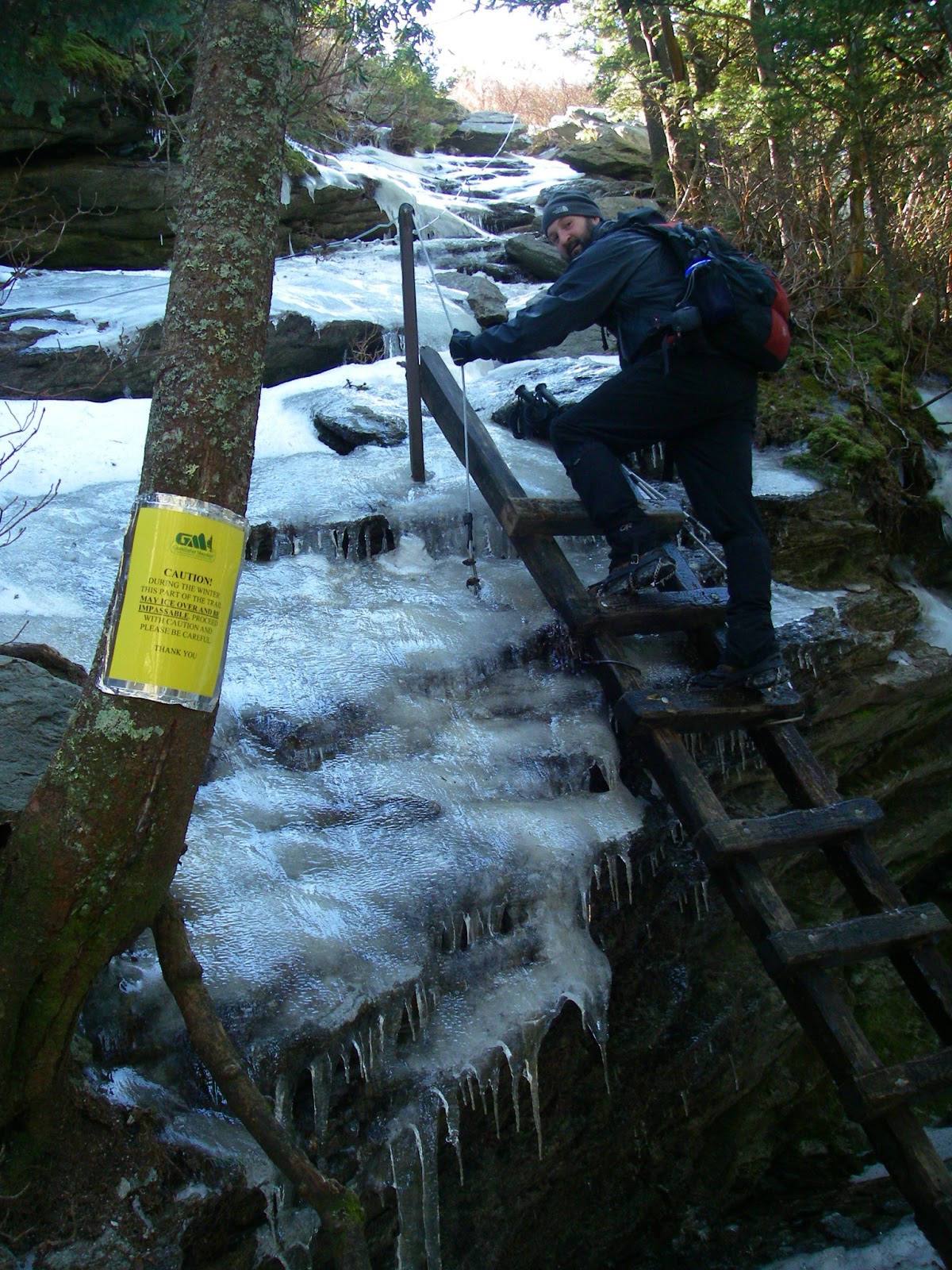
Not a problem. Photo by Tommy Bell
Before this hike, I was thinking Winter was winding down. I was kind of bummed about that, not because I love cold weather, but because I hate hot, humid weather, and also partly because I had just had the good luck to win a pair of crampons from the writer of another hiking blog I follow, Section Hiker, whose owner regularly tests and gives away gear. I figured it was going to be at least December before I would have a chance to try them out, on my usual Christmas visit to the Catskills. But, lo and behold, we had another wave of cold and snow, and I found out that the higher trails of Grandfather Mountain were supposedly very icy! My buddy Tommy had been wanting to return there as well, so it ended up being a no-brainer where to hike this weekend. I wasn’t really expecting to need full crampons for the hike, only my usual microspikes, but I figured I would at least have a chance to put them on and try them out somewhere. Well, there turned out to be far more ice than I would have ever imagined. 

We started up the Profile Trail on dry ground, and I had doubts about just how much ice there was going to be. But around the 4,500’ elevation, a little snow started to appear and the trail slowly became more and more icy as it climbed higher and higher. We passed below the cliffs that form The Profile, and the spectacular off-trail pinnacle of Haystack Rock - a spot I have long wanted to visit. Since off-trail hiking is frowned upon in the park, going there would be ill-advised, though I’m certain a few people have found the appeal to get off the beaten path too great, and have done so, especially when the reward is so obvious.

On Calloway Peak
By the time we reached the crest, traction devices were definitely a good idea. The trail was mostly a ribbon of hard ice, with only intermittent sections of dry or snow-only covered footbed. Even though I had microspikes, I decided that I wouldn’t look like an idiot wearing full crampons after all. Especially on the many of the steep, rocky sections, the ice was heavy and treacherous enough that it was probably pushing the limit for microspikes anyway. With my new footgear though, I could feel the 10 steel points on each boot bite into the ice, and felt remarkably sure-footed. I was able to walk on the ice in most places as though it were dry ground, a liberating feeling.

Looking toward Attic Window Peak
After gaining a little more elevation and climbing a couple of short ladders we made it to the 5,964’ summit of Grandfather Mountain, a.k.a. Calloway Peak. The views from this highest point in the Blue Ridge are always great on a clear day, as this was, and include the crest of the even higher Black Mountains, the apex of these Eastern states. We took it all in for a few minutes, then reversed our route back down into the gap to the southwest to continue our icy trek.
 
The terrain flattens out briefly beyond here, but soon enough we were back on steep, ice-covered rock. There are definitely spots here where you would not want to fall in Summer conditions, but that number increases exponentially with ice because of the possibility of falling, then sliding over something that you do not want to slide over. A good many of the cliff faces up here are well over 100 feet high. Even if you don’t go over a cliff, there is still the hazard of gaining momentum and sliding into something, like another rock. Today it seemed that many of the places you would least want ice had the most. But we were careful, and had no real issues, only awe and great joy at being here on this spectacular ridgeline of crags and wind and views.


Tommy below Attic Window Peak.
After reaching the top of Attic Window Peak, we headed down the Class 2 chute (maybe Class 3 with ice) on its west side, then through the short underground section where the trail goes beneath a huge jumble of room-sized boulders that have fallen off the cliffs over the millennia. The most formidable section of trail turned out to be just ahead, on the climb up MacRae Peak, a.k.a. Raven Rocks. Just above the gap, a short ladder scales a low cliff at the bottom of a steep slab of bare rock. There is a rubber-covered steel cable with knots in it, anchored on both ends, to act as a handrail of sorts on this, an appropriate safeguard for when the rock is wet. It seemed totally inadequate, even laughable, for the several inch thick layer of clear ice that plastered the rock today. You wouldn’t fall to your death here, but it wouldn’t feel good either. But we were game, and again had no problems. Amazing what you can do with the right gear! We were careful nevertheless. We actually met a guy coming down this with no spikes, but he certainly was envious of ours, and we didn’t envy him. I have no idea how the guys we later saw in tennis shoes fared on this, but it couldn’t have been pretty or graceful.


Heading underground temporarily. Photo by Tommy Bell
Minutes later we were climbing the ladder onto the overhanging summit block of this spectacular peak, one that would probably be a short, but technical and exposed climb without the ladder. It has an airy feeling to it for sure, and the violently gusting wind only exacerbated that feeling, tending to make one avoid the edges. But the views are simply superb, with the wild cliffs of Attic Window Peak close by on one side, and the almost exotic forms of Hawksbill and Table Rock off in the distance to the other direction. Of course, you have to take the good with the bad. This summit also gives one of the closest views of that monstrosity of a condominium on nearby Sugar Mountain that blights so many other summit views in this part of North Carolina, an eyesore that, in my opinion, should never have been built. But what’s done is done, and I find I can usually ignore it. Actually, I am often amazed at how far away it can be seen from, and sometimes use it as a very distinguishable landmark when trying to identify other nearby peaks.

Icy trail up MacRae Peak. Photo by Tommy Bell

Topping out on MacRae Peak. Photo by Tommy Bell
Attic Window Peak from MacRae peak.
Tommy on an overhanging outcrop on MacRae Peak
We had one final view of MacRae Peak.
We decided to skip the high ladders and more cables that descend the south side of the peak, followed by looping back around the west side on the Undercliff Trail. No doubt it would have been spectacular, maybe even scary, but we opted to simply backtrack from here, satisfied with the day. Headed back down the Profile Trail, we stopped briefly at Shanty Spring to admire the large icefall there and poke around at the nearly invisible beginning of the long abandoned Shanty Spring Trail, the route I used on my very first visit here back in 1991. A little farther and the trail of ice began to disappear.
The Profile, Haystack Rock, and Calloway Peak.
Even as I write this a month later (way behind on my blogging), similar conditions still persist on this amazing mountain. As of March 23, the state park website offers these warnings, tempting me to head there again, to the trail of ice, before Winter really is gone:
> 3/24/13 Fresh snow and ice. Trails remain slick.
> Please be advised: even with warmer weather, higher elevation trails will still have slick conditions for some time. There is still snow and ice below Calloway Peak and to Grandfather Mountain Attraction with intermittent deep snow drifts along the ridge line. Proper gear and clothing, adequate food/water and winter hiking experience are necessary for hiking at higher elevations. Caution: Ice traction is essential. Be alert to ice, snow and possible downed tree limbs on the park's trails.

Some of the trails on Grandfather Mountain. To view a larger map click here.

Hike Stats:
7.7 miles, 3,050' cumulative elevation gain via profile trail and back

Pictures from this hike
Pictures from other hikes to Grandfather Mountain
July 2011
July 2008
June 2007

Resources:
gpx files and maps
North Carolina State Parks Grandfather Mountain site
Grandfather Mountain State Park maps and directions
Grandfather Mountain private attraction site
SummitPost page - has additional links for each peak and routes


View Larger Map
Profile Trailhead coordinates:
36.12175,-81.83009

Google map for trailhead

Scan QR code to navigate to trailheads with Google Maps on your smartphone