Showing posts with label peakbagging. Show all posts

Tuesday, August 19, 2014

Exploring Wild Basin


After a warmup day on Hallet Peak, it was time to start acclimatizing to the altitude and begin exploring in earnest. Our plan for doing this kicked off with a three day backpacking trip into the Wild Basin area of Rocky Mountain National Park. Even though Longs Peak was the main objective, and promised to be the biggest prize of the entire trip if we proved successful in the attempt four days hence, I think I was looking at this three day outing as the highlight of the trip, with a chance to bag four or five nice peaks in a less visited area of the park. Unfortunately, things didn't work out according to plan - but it was still a great three days in one of the lesser traveled but nevertheless spectacular areas of the park - and probably the best backpacking trip I have had the pleasure of doing in Colorado.

Ready to start a three day hike into the backcountry of Wild Basin. Photo by Bill Walker
Destinations! Photo by Steph Petri
We arrived at the trailhead too late to really give climbing Mount Copeland any serious consideration, but after shouldering our packs, we headed up North St. Vrain Creek on the Thunder Lake Trail. It was easy hiking the first few miles to the North St. Vrain campsite, and we stopped briefly at the two low waterfalls of Lower and Upper Copeland Falls. Upon reaching our campsite, already late morning, we ditched all of our overnight gear and extra food (in bear canisters), then headed up the Bluebird Lake Trail. It didn't take long at all until the trail climbed up onto a low, minor ridge that was surprisingly open even though still well below the treeline, apparently part of an old burn area. Along the way, there were awesome views of Mount Meeker and the forbidding looking Homestretch of Longs Peak, as well as an inspiring view of Tanima Peak and Mount Alice. As we became more walled in by the surrounding mountains closer to Ouzel Lake, the scenery was dominated by Mount Copeland, Ouzel Peak, and Mahana Peak. Gaining elevation, it became increasingly subalpine and we walked through some very nice wildflower areas. Among others, there were lots of beautiful yellow snow lilies and "little pink elephants". We also began to see lingering snow patches close to us, and at one point, there was even a really neat looking snow bridge across Ouzel Creek, and we couldn't resist the urge to get a closer look. I didn't think it looked safe to get on, and certainly not to get under, but it presented a tempting photo opportunity as it was in a steep, narrow gorge with the creek cascading out from under it, while above it were massive rock walls and deep blue sky with fluffy white clouds - a classic mountain scene if ever there was one. There was a bit of excitement while here, something that certainly reinforced how unsafe these things can be. While Steph and I were standing beside it on its downhill side, a chunk of snow the size of a Volkswagon broke off of its upper side and crashed into the creek with quite a rumble, one that made us quickly back away as soon as it started to happen. No harm done, but it is something I will always keep in mind in the future. Dave was lucky enough to get part of it on video!

A great view of the Homestretch on Longs Peak (left) and Mount Meeker (right). Photo by Dave Socky
Tanima Peak and Mount Alice from the Bluebird Lake Trail.
Above here the trail steepened as it began to leave the trees behind and climb up into the cirque containing Bluebird Lake, whose steeply cascading outlet was in sight, providing more visual and auditory stimulation. Just below the lake, the trail went into a steep, narrow gully still filled with snow, and I'm pretty sure it was the first time that either Bill or Steph had walked on snow in August.

The lake itself was an ice cold emerald beauty nestled in below the rugged slopes of Ouzel Peak and Mahana Peak. There were a couple other guys here swimming, but we did not indulge. Not only was the water little more than snowmelt, there was a brisk chilly wind blowing as well. Just the thought of getting in was enough to shock my system. Had it been earlier in the day, we could have tried to climb into an even higher basin between us and the Continental Divide where there is yet another lake, slightly smaller and with the name of Pipit. Once there, it is also a relatively straightforward climb to the summits of Mahana and Isolation Peaks, but those simply weren't in the cards for this day, as it was well after noon and there were dark clouds building. In fact, it was threatening enough that we didn't linger but a few minutes before turning back for the safety of the trees nearly three miles away and 1,400 feet lower.

We then had the luxury of a few relaxing hours in camp before turning in early for a big next day.


"Little pink elephants" is one of the names for these pretty wildflowers.
A neat snow bridge, part of which collapsed while we were beside it. It made quite a rumble!
A snow ramp up a still buried section of the trail near Bluebird Lake.
Bluebird Lake and Ouzel Peak. Photo by Bill Walker
The next morning we were on the trail at 3:30 a.m., making an alpine start to the day I had been looking forward to at least as much as Longs Peak, that being an attempt to climb Mount Alice and Tanima Peak. It's kind of hard to explain this, because Longs is considerably higher, more famous, and has been a goal of mine for far longer. Perhaps that is because in some ways Longs seems more daunting, despite the fact it has a marked and well established route that is attempted by roughly 15,000 people every year and has a 50% success rate. Maybe it is also partly because of those crowds, which I don't like. Mount Alice, on the other hand, is technically no more difficult and maybe even a little less so, but is unmarked and far, far less visited. In fact, we would see no else even trying today. Being lower, it also seems somewhat less committing, but it also has more of an element of the unknown about it (especially the descent from Boulder-Grand Pass) - both these things also having a certain amount of appeal. Perhaps it is also partly that it has a more unusual form, arguably looking a little more exotic. There was also the appeal of it being a traverse of two peaks and a loop, rather than an up and back of one peak. Regardless of the reasons, it was something I was excited about trying. 

On the trail at 3:30 a.m. on Day 2, to move camp up to Thunder Lake, then attempt Mount Alice. It would prove to be not early enough. Photo by Steph Petri
Because of not being able to get the campsite we had wanted the first night, we were forced to get up at 3:00 to get ready and actually break camp so we could stay at Thunder Lake after our climb. This required hiking three miles and 1,200 feet higher in the dark, which seems a pretty modest undertaking based on previous experiences, but it still took us until after dawn to get there. This little fact had already given me doubts about the day, but I tried my best to suppress them from myself. Since the campsites at Thunder Lake were currently in use and we weren't entitled to one until later in the day, we found an out of the way spot and once again hid all of our overnight gear and extra food to retrieve later. Then we continued on our way with lighter packs for the actual climb.

The first act was to actually backtrack a short distance, then bushwhack from the Thunder Lake Trail to the Lion Lake Trail, which had the benefit of saving us an unnecessary descent of 600 feet and over two miles of hiking in order to stay entirely on trails to the start of the actual climb. The forest was relatively open, so the bushwhack itself was uneventful and a smart move. Once back on the trail, we found a good view of the descent route from Boulder-Grand Pass. This was something that I had nagging doubts about the difficulty of, because if it proved too hard for us, we would have little choice but to backtrack over Mount Alice again. I was relieved to see that though it looked "interesting", it also looked to be reasonable with some care via a steep and narrow gully incised into the headwall of the cirque above Lake Of Many Winds. 

Boulder-Grand Pass is the low spot between Tanima and Alice, and was intended to be our descent route after climbing both peaks.

The next highlight was at Lion Lake Number One, where there was a perfect reflection of the pointy summit of Mount Alice looming some 2,200 feet above its dead calm sapphire waters. It was such a perfect scene that I thought Steph should see it in its entirety at first sight, rather than appear gradually as it had for Dave, Bill, and myself as we approached the shore. Steph had been a little behind us when we got here, so I stopped her short of the lake and asked her to close her eyes and let me lead her to the water's edge before opening her eyes. I think it was a scene she will long remember. There were also great views of Tanima Peak as well as Mahana Peak and Chiefs Head from here.

Mount Alice and Lion Lake Number One.
The maintained trail ended here and we continued up a climber's path towards Trio Falls and higher into the basin which contains Lion Lake Number Two and Snowbank Lake. We had to climb a small, steep snowbank to get above Trio Falls and to the next lake, where we took another snack and water break before working our way onto the long tundra ridge that leads to the Continental Divide in the pass between Mount Alice and Chiefs Head Peak. Despite how good it had already been, this is where the scenery began to get really dramatic. From the lower end of this ridge is perhaps the best view of the massive cliff face on Mount Alice known as the "Mini-Diamond", a reference to the even bigger and world famous face of The Diamond on Longs Peak. There is an equally dramatic view of Hourglass Ridge, which is the rugged ramp that the route to the top of Mount Alice follows. This sloping, cliffbound ridge looks even more daunting as one climbs higher and closer to it, so much so that Bill at one point asked me, with some concern in his voice, if I really thought we could climb it. Looking at it carefully though, I thought, as is often the case with things like this out West, it wasn't as difficult as it appeared at a quick glance. This was a point of view that Dave agreed with me on, but we would ultimately have other concerns by the time we reached the Continental Divide and the start of Hourglass Ridge.

Our route was to follow the center ridge to the pass, then continue up the right skyline of Mount Alice (left). Chiefs Head Peak is on the right. Photo by Bill Walker
Mount Alice looking a bit more formidable, but doable. It doesn't show in this photo, but there were a number of ominous looking clouds building around us at this point. Ultimately, we decided the risk of getting caught in a thunderstorm was too high and we turned around - a difficult but smart decision. It ended up not storming after all, but taking chances with afternoon thunderstorms above treeline during the Colorado Summer is like playing Russian Roulette - you only get to be wrong one time. Photo by Dave Socky
We had been unable to see much of the sky to the west of us until we reached the divide, but even though it was still a little before 11 a.m., there was a mass of very dark, threatening clouds moving toward us. Climbing Alice would mean gaining another 900 feet and probably take another hour. I wanted to continue so badly it hurt. The top was within grasp and despite several truly awesome trips to the Northeast mountains in recent years, I had not been anywhere this dramatic since 2007. I think Dave felt the same way as me, but being so new to the West and having no prior experiences to base what to expect from the remaining climb and the questionable weather, both Bill and Steph were very apprehensive about going any farther. The truth is that this was unquestionably the right and smart response, and I knew it. Being above treeline and on the peaks during Rocky Mountain thunderstorms is like playing Russian roulette - one lightning strike is all takes to never climb another mountain. In fact, two people had been killed by lightning in separate events and several others injured in different parts of the park a week or two before we arrived. We decided to turn back rather than risk it. But before doing so, I did get close enough to the start of Hourglass Ridge to truly determine that it was not as difficult as it appeared. In fact, it actually looked very straightforward - a fact that I committed to memory with a plan already taking form in my head.

The sky that ultimately  made us decide to abort our climb. Photo by Dave Socky
This certainly didn't mean our climb had been without great reward. We were now standing in a very dramatic place with wild scenery all around us. The closest and most obvious was the ragged ridgeline up Alice and the adjoining cliff faces on both sides of it, but there were also awesome views of Chiefs Head Peak and Mount Meeker, the park's second and third highest peaks, as well as dramatic McHenrys Peak and its distinctive notch. Then there were the more distant peaks of the rugged Never Summer Range, the veritable canyon of North Inlet right below us, and the whole of our route here from camp. It was fully worth it just to get to this magnificent prospect in the heart of Rocky Mountain National Park.

McHenrys Peak from the Continental Divide below Mount Alice.
Having made our decision though, there was nothing left to do but start making our way back to the relative safety of the trees as we were still far from safe here if it started storming. Of course, as luck would have it, it never did storm...

Back at camp, and with some pent up energy and enthusiasm remaining, I decided I was going to walk down to Thunder Lake and then explore up into the basin leading to Boulder-Grand Pass, which would have been our descent route. Dave and Steph also decided to tag along at least as far as the lake, where Steph couldn't resist the temptation to go swimming. That was a rather entertaining and short-lived activity as she lasted about five seconds in the icy cold water! I continued on from here and was pleasantly surprised to find a good climber's path continuing on. I had only the vaguest notion that I would reach Lake Of Many Winds, much less Tanima Peak or even just the pass.  Ultimately, I ended up climbing about 500 feet higher before the weather started threatening again, but I now knew that there was an easy route down from high in the basin if I could just get down from the pass. I think you know where I am going with this, but even I wasn't certain yet and I eventually headed back to camp for the evening.

After dinner, I decided, with the blessings of the others, that if I woke up early enough and felt good about it that I would make another attempt on Mount Alice and Tanima Peak the next day. Knowing that after hiking out to the trailhead afterwards, we were going to be hiking in to another campsite to position ourselves for the climb of Longs Peak the following day and would be getting up at 2 a.m. for that, Bill and Steph decided that they were going to sit it out and relax at camp. Dave had more of a struggle deciding, and he was sorely tempted to join me, but ultimately he too decided to forego the climb.

When I woke up at 2:30, I decided that, yes, I wanted to try this again. While some people climb Alice and Tanima in a day from the trailhead, I was now glad to have the previous day under my belt as a reconnaissance trip for a solo climb. I had much more information to go on and very little apprehension, other than still just a little about the descent from Boulder-Grand Pass. I was on the trail alone at 3 a.m. and moving reasonably quick. Having a gps track from the previous day made the bushwhack in the dark a pretty simple matter, as it did for the slightly tricky section from Lion Lake Number One to gaining the crest of the ridge above Lion Lake Number Two. At 6 a.m., with dawn just starting to break, I found myself standing where we had turned around yesterday. I watched the sunrise over Mount Meeker as I started up Hourglass Ridge, and true to my assessment, it was steep but very straightforward and not at all scary or technically difficult. In fact, I would say it was mostly Class 2, with only a few spots perhaps being the next class higher. It was certainly well within my comfort levels, even alone. In fact, I made it up the summit cone to the top in 30 minutes, not the hour we had estimated it would take yesterday.

I left camp alone at 3 a.m. on Day Three, and made it to our previous day's turnaround point in time to see the sunrise over Mount Meeker before continuing up Mount Alice.
Looking down at our previous day's turnaround point at the notch at the base of Mount Alice's summit cone.
On top I was at 13,310' above sea level, and very happy to be the highest I had been since standing atop the Grand Teton in 2006. It was a tremendous feeling! While this terrain is no Canadian Rockies or North Cascades, it is still undeniably sublime with its enchanting mixture of broad slopes and ridges of high tundra culminating in sheer cliffs, cirques, narrow, ragged ridges, and distinctive peaks. The views were terrific! Longs and Meeker dominated to the northeast, but were by no means the only show. Stretching north and south were the nearly countless other peaks of the Front Range while many of Colorado's other ranges marched off to the horizon to the northwest, west, and southwest. The oceanic vastness of the Great Plains lay spread out to the east as far as the eye could see. Closer at hand, still in early morning shadow and 2,700 feet below, was Thunder Lake and camp. Presumably the rest of my group were still in their sleeping bags or perhaps just beginning to stir for the day.

There was an icy wind on the summit, and it looked and felt as if it might snow at any minute, or rain - which would be even worse at just above freezing high on the Continental Divide. But at least the sky didn't seem to have any thunderheads in it. Nevertheless, as I started working my way down first the boulders on the south side of the summit, then the gentler tundra slopes leading to Boulder-Grand Pass, I decided that I was going to skip the easy climb of Tanima Peak. One reason was because of concern over what the weather might do. Another was because I didn't want to keep the others waiting an extra hour for me. I simply decided I was content with the bigger prize of Alice for the day.


Looking towards Tanima Peak, the low, rounded ridgeline just above the center of the photo. It would have been an easy climb from Boulder-Grand Pass, but it was only about 35 degrees and very windy when I got there, and it looked and felt like it might rain or snow at any minute, so I ultimately decided to descend and be content with Mount Alice alone.
Longs Peak, Mount Meeker, North Ridge, and Thunder Lake.
Nearing the pass, it was time to find out just how hard it was going to be to escape it. The obvious route on the topo or at a quick glance is to simply drop down the headwall of the cirque beneath the pass, but in person there is a snowfield there that is far too steep for the average person like me to safely descend without crampons and an ice axe. However, just to the north of here is a narrow gully that doesn't show up on the map. And seeing it from a distance in person, it still doesn't look particularly inviting. However, it is snow free in late Summer and actually creates a break in the angle of the headwall. While this gully is still very steep and also very loose, with caution it is relatively easy as there are just enough solid hand and foot holds to get down it safely if you look for them. I had no trouble getting down to Lake of Many Winds, which it turns out is well named. Buffeting gusts of wind seemed to be swirling around and hitting it from every side. I climbed up on a little nondescript knoll by the outlet of this tiny alpine lake and had a few snacks while gawking at the scenery, including the daunting Homestretch of Longs Peak and looking at what I had just descended. It didn't look too bad from here, and was clearly the best and safest way down. After another steep half mile I was back on ground I had stood on yesterday and had easy going back to camp. The rest of the gang was just starting to break camp and it didn't take me long to start doing the same, still ecstatic about how the first half of my day had gone.


Another view down the descent gully. Aptly named Lake of Many Winds is visible below.
Longs Peak and Mount Meeker one more time.
Now we had a six mile downhill hike back to the trailhead, the first half of which we had climbed in the dark the previous morning. As a result, we got to more fully experience a viewpoint we had walked past when all we could see were stars and silhouettes of mountains. But the hiking for the day was not yet over. We piled into the car with our exploding gear as best we could, then drove a few miles up the road toward Wind River Pass and the turnoff for the Longs Peak trailhead, parking at an elevation of 9,400'. It was early afternoon now, and we spent probably a solid hour in the parking lot repacking, reorganizing, and restocking our gear and supplies for the climb of Longs Peak which towered very nearly 5,000 more feet above us. Our only remaining goal today was to hike another 1 1/4 miles up the trail to the Goblins Forest campsite and get 700 feet of that climb behind us. By the time we started up the trail, it had started raining, but luck was on our side and it only lasted a few minutes. I hadn't even bothered to put on rain gear before it quit, though I was on the verge of doing so. We spent a few relaxing hours in camp, then turned in early knowing that the biggest highlight and challenge of the trip lay ahead of us the next day.


Dave's video of our hike to Bluebird Lake.


The profile of our three days in Wild Basin, separately and combined.

A topo map of our three day hike in Wild Basin. Red is Day 1, purple is Day 2, and green is Day 3. To see the topo map larger on this site, click on the map. Or click here to see a larger interactive version on CalTopo where you may also print the map, generate a pdf, create a kmz map for use in Google Earth or as a custom map for some Garmin gps units. Additionally, you may download gpx and kml files from the site. No sign in is required to do any of this.

Hike stats: 35.6 miles and 9,170' total for three days in Wild Basin

More pics here or here.

Trailhead coordinates for Wild Basin40.2079, -105.5664


created with Chrome OS and various webapps


Saturday, August 16, 2014

Hallett Peak - A Great First Day In Colorado


Time for the fun to really begin! We hit the road from Denver at 5 a.m. and made it to Estes Park shortly before 7 a.m. with some awesome views of Longs Peak enroute. We grabbed a quick bite to eat and then drove up to the Bear Lake trailhead for a hike in one of Rocky Mountain National Park's iconic areas. Our goal was to climb Hallet Peak by way of Flattop Mountain. 


Stephanie ready to climb Hallett Peak.
This was a trail hike all the way up to the top of the broad, aptly named summit of 12,324' Flattop, reaching treeline after only a couple miles and giving us nonstop great views in every direction except west. Hallett loomed impressively above us, as did the awesome massif of 14,259' Longs Peak, while the depths of Tyndall Gorge was below us. Actually, it was a shoulder of Hallet that loomed above us. The well known scene of the blocky cliffbound peak above Bear Lake is not the summit, nor is the summit visible from there. One must get a good way up the trail to Flattop to see the true apex.  Needless to say, Stephanie and Bill were impressed (this was also Bill's first time out West). I was feeling strong after having ran stadium stairs all Summer in anticipation of this trip, but stuck with the group until we were a good ways above the treeline. At some point though, I started pulling ahead and just kept going to the summit of Flattop, a rather nondescript point on a broad summit excepting the fact it was on the edge of Tyndall Gorge, above treeline, and surrounded by magnificence. 


On Flattop Mountain, gazing towards Longs Peak. Photo by Steph Petri

Tyndall Gorge. The road's end trailhead parking lot is plainly visible below and right of center, about 3,000 feet below our position in the col between Flattop and Hallett Peak. Photo by Bill Walker
The final ascent of Hallett Peak. Photo by Bill Walker

After a short break on Flattop, we continued the remaining 500' up the much more impressive looking Hallett to its 12,713 summit. It didn't take me long to decide this is probably the most impressive thing I have ever done in Colorado. And the feeling of finally being back in the awesomeness of the Western landscape was almost overwhelming. Hallet may not be exceptional by Western standards, but even in the Northeast that I so dearly love, it would likely claim the status of "most spectacular", beating even Katahdin. That kind of makes me sad, but it's the truth. The summit is not a spire by any means, but it is small and distinctive enough - and steep and cliffy enough - to be inspiring. And it is surrounded by a mixture of deep, cliff-bound cirques and small glaciers, and other dramatic peaks to the east, north, and south as well as large expanses of rolling alpine tundra on the western side of the Continental Divide. Farther east, beyond the foothills of the Front Range are the Great Plains stretching to the horizon and far beyond. Farther west and south are more rugged ranges of the Rockies, including the dramatic Never Summer Range and the Gore Range. Then, lording above all else in the area, is the dramatic truncated cone of 14,259 foot Longs Peak.

A closer view of Longs Peak looking rather forbidding. Photo by Dave Socky
We were in no big hurry to leave this wonderful eyrie, and probably spent at least an hour on top eating, gawking, and talking excitedly about our surroundings and the coming days. This had been an excellent goal for our first day in the mountains, but eventually there was nothing left to do but descend back to the lowlands and prepare for the next adventure.


Dave's video of our day on Hallett Peak.

Elevation profile for the climb of Hallett Peak.
To see the topo map larger on this site, click on the map. Or click here to see a larger interactive version on CalTopo where you may also print the map, generate a pdf, create a kmz map for use in Google Earth or as a custom map for some Garmin gps units. Additionally, you may download gpx and kml files from the site. No sign in is required to do any of this.


Hike stats: 9.7 miles, 3,278' cumulative elevation gain

More pics here or here

Trailhead coordinates for Hallett Peak: 40.311791, -105.644336

Google Map for trailhead

Created with Chrome OS and various webapps

Friday, August 15, 2014

A Prelude To Colorado 2014

Triumphant atop mighty Mount Sunflower after an arduous and daunting climb. Photo by Dave Socky

I can't believe it has been eight years since I last went out West, but that trip - to Idaho - was way back in 2008. Way too long, especially considering that several years in the past twenty I have made as many as three trips out in a single year. That's obsession! The last few years I have concentrated on trips to the Northeast, another region I dearly love and am far from being done with, but going West again was long overdue and I found myself justifiably and expectedly excited! Now, after committing to my buddy +David Socky late last year to going to Colorado this year, and hoping that nothing would come up to prevent it, the day had finally arrived!

Planning was uncharacteristically lackadaisical early on, beyond making an attempt to climb 14,259' Longs Peak the primary goal and desire of the trip. Excepting myself and Dave being in, the other details were fuzzy at best but had the number of people potentially interested running as high as eight or nine people. It was more or less a given that we would drive out though, and that the bulk of the trip would be spent in Rocky Mountain National Park, and perhaps the adjacent Indian Peaks Wilderness. Eventually the group solidified at four, with +Stephanie Petri  and Bill Walker claiming spots, while others either never committed in the first place or had to back out. I found it kind of exciting that this would be the first time that either Steph or Bill had ever been out West, and knowing how it has affected me, I couldn't wait to see their reactions to all the awesomeness I knew we were going to experience.

With only a couple of months left to go, the real planning finally kicked in and we started ironing out details, creating an itinerary complete with alternatives and some openess, and making any necessary arrangements and reservations. We ultimately settled on spending the bulk of our time in Rocky Mountain National Park, where we would do a couple of dayhikes, a three day backpacking trip, and a climb of Longs Peak. And we couldn't go all the way to Colorado without Steph and Bill having an opportunity to bag the state highpoint, so we allowed for a couple days around Leadville for that, and possibly for La Plata Peak as well.

With only a few weeks to go, it seemed that Bill would not be able to get quite enough days off work to allow for the drive, but he decided he could fly to Denver and we could pick him up after our two day drive, and drop him off again at the end of the trip, thereby allowing him to leave after work on a Friday and fly back home the following Sunday while the remaining three of us would leave on a Thursday and return home two Mondays later. This wasn't necessarily ideal for Bill, as he was actually wanting to join in the cross country drive, but at least he could still do the important stuff, and it would make the drive out for the remaining three of us much less cramped in the car. 


The Facebook post said: "We're coming to kidnap you and make a run for Colorado Rick!". Photo by Steph Petri
The last few days really dragged by but the excitement levels increased, then Dave and Steph, whose journey had already started a couple hours earlier, pulled into the driveway and it was finally time to go! I loaded my slightly excessive amount of gear into the car, kissed Leanne goodbye, and we hit the road. "Suffer-fest 2014" was underway! Well, actually the itinerary seemed a bit less ambitious than my usual "vacations", but we were going to be dealing with significantly higher elevations than usual -  a fact that would compensate for the lower average daily miles and elevation gains compared to the trips I usually plan to the Northeastern mountains.

Things were uneventful the first half of our non-stop drive, but excitement levels increased as we knocked off the Eastern states one by one. Virginia went fast and West Virginia only took a couple more hours. Then we slowly passed through Kentucky, Indiana, and Illinois before reaching the psychological point of crossing the Mississippi and Missouri Rivers at the so-called "Gateway To The West" of St. Louis, Missouri and its iconic arch around the not too bad hour of 10 p.m. Beyond here it was all new ground to Steph, and we rolled into Kansas about four hours later.

As it turned out, our timing didn't allow Steph to really witness the gradual progression from the forested East to the treeless Great Plains. Excepting the always present small islands of them, we had already left the trees behind us when dawn began to break. Now we were but small specks in the oceanic vastness of the open prairie, mostly about as flat as you can imagine, but still with occasional rolling terrain in the form of low and very broad "hills" if you want to call them that. It is actually a pretty neat experience, especially the first time. If you have lived your whole life in the forested East and the Appalachians, it is hard to imagine just how flat, open, and expansive the Plains can be until you experience it in person. And though it mostly lacks the rugged landscapes we were heading for, the farther one moves into this region the more they begin to feel like they are in "The West". We had dropped down to an elevation over 14,000 feet lower than the hoped for high point of our trip on Mount Elbert when we crossed the mighty Mississippi and Missouri Rivers, but through the night we had imperceptibly climbed back up to 3,000' when we stopped for breakfast in Oakley, Kansas.

Searching for the Kansas state highpoint. Photo by Dave Socky

Maybe it's on top of that hill...

It's that way!


Conquering mighty Mount Sunflower (or getting conquered by it?). Video by Dave Socky

We were now only a couple hours away from the first objective of the trip, the Kansas state highpoint of Mount Sunflower. The drive there gained us yet another thousand feet of elevation - and put us within a couple thousand feet of horizontal distance from the Colorado state line, where the landscape continues on just as flat as Kansas. Dave had been here once before, only a year ago, but it was a new state for the completion list for Steph and myself, and my first new one in several years which just bumped me past the halfway point with 26. While indeed very flat, this 4,039 foot high "summit" is indeed the top of a hill, complete with two closed 20' contour lines surrounding it on the topo map. There is a neat summit marker and, despite our joking around, I actually found it to be a surprisingly pleasant spot with views for miles around and a feeling of being somewhat remote thanks to its distance from the interstate and the relative scarcity of people and houses anywhere nearby. Happy with our prize, we headed into Colorado.

It took a couple more hours, but finally, near the town of Limon, the snow-patched heights of the Rocky Mountains began to show on the horizon, almost like apparitions at first, then slowly becoming more real. This is always an exciting moment after a cross-country drive through the plains, but was especially so for Steph since it was her first visit. I remember well how emotional I felt the first time I saw 14,110' Pikes Peak looming up some 80 miles away with snow still on its upper reaches in late August of 1994, and it seemed equally so for her. In fact, she was almost giddy with an excitement that only continued to build as we gradually drew closer to the landscape of enchantment. It was really fun to witness this, and I knew she was going to have a great time. I knew I was too, and I was fully expecting this to be my best trip ever to Colorado.

Later this night, after making a run into the Denver REI, gawking at Longs Peak towering above all else 45 miles away, and having some dinner, we picked up Bill (and Steve M F Wolf) at the airport then turned in for a few hours before our true adventures began...


Tuesday, October 8, 2013

On Becoming An Adirondack 46er! - Part 3

On October 5, 2013, Peter Barr and I became Adirondack 46ers atop the 4,150' summit of Sawteeth

We had started planning our return for this year during the drive home last year. By the time +Peter Barr  and his wife +Allison had finished their Summer visit to the Northeast a couple months earlier, he still needed eighteen peaks to my nine, but we had agreed that it might be possible for us to both finish on this year's trip. It was ambitious, and would require everything to go just right, but it was possible and sounded like a great idea to me. I had also gotten +David Socky  interested in joining us, not because he was particularly interested in the 46ers, but because it promised to be a great trip with lots of good hikes. I was quite excited when the day of our departure finally arrived, especially when the 10 day forecast looked unbelievably good.

Halfway! Dave's 25th state highpoint.

Hitting the road around 5 a.m., we drove pretty much nonstop except for gas, and made it to Port Jervis, NY early enough that I suggested we make a quick drive up to the nearby New Jersey state highpoint so that Dave could add it to his growing list of completions. Accurately, but unimaginatively named High Point, this 1,803’ foot mountain was Dave’s 25th state high point, and along with a scale replica of the Washington Monument on its summit, on a clear day it actually has surprisingly good views of the Kitattiny Ridge, Hudson Highlands, and Shawangunks, as well as the higher and more distant Catskills. We did not linger long, as we had hopes of doing a short hike in the Southern Adirondacks before dark. I had tried to fit Crane Mountain into other trips before, but it had never quite worked out. This time it did. We got to the trailhead with, as it turned out, just enough time to do a great four mile loop to the cliffy summit of this classic hike and start the trip off right. The rest of the week would be spent climbing Adirondack 46ers.


Peter on Crane Mountain. Photo by Dave Socky

Dave crossing the Hudson River.
We decided to start the remainder of the week off by "eating the frog first" and doing what would probably be two of the hardest hikes of the trip on the first two days. The pick for Day One ended up being Allen Mountain, a peak that doesn't have a reputation for being the most spectacular in the Dacks, but does have the distinction of being one of the most remote, as well as requiring possibly the longest hike to get a single peak, a near twenty miler. One can normally bag several Adirondack peaks on a hike of this length. It has the additional difficulties of two river crossings, several normally boggy areas, and the notoriously slick "red slime" on the wet rocks of the mountain proper. Much to our pleasure, we had a comparatively easy day, a theme that would be true all week thanks to dry weather. The crossings of both the Hudson and the Opalescent Rivers were relatively easy rockhops, and there was little in the way of mud and boggy areas. We did still have the algae slickened rocks and steepness of the actual climb of the peak to deal with though, so it wasn't a “gimme” by any means, and we still barely managed to finish by dark, therefore having no chance of also tacking on a side trip up Mount Adams. That firetower peak will have to wait for another time, but it had turned out that Allen had surprisingly good views of its own, particularly toward the Great Range. Sawteeth, the peak we hoped to finish the 46ers on later in the week was in plain sight too, which was pretty neat.

Sawteeth (right center) would be my and Peter's final ADK 46er peak at the end of the week. Our ascent route would follow the Scenic Trail across the "sawteeth" of the right ridgeline.

I stepped in an Adirondack booby trap on the way back from Allen.

The next morning we were on the trail shortly after it got light and soon enough we were heading up Santanoni Brook. Once we got onto the herd path at Bradley Pond, things were straight up as usual and we began the root grabbing, rock scrambling ascent to Times Square, thence to the summit of Panther Peak and its excellent views. Of course, there was also a perhaps too good view of the little bundle of joy that we were heading for next. That would be 3,792' Couchsachraga, "affectionately" known as "Cooch". Since this peak actually misses being a 4,000 Footer by over two hundred feet - and isn't even a ranked peak, I think most people are annoyed by the fact that it remains on the list. It would probably elicit less animosity if it were easy, but the simple fact of the matter is that it requires a side trip of three miles, losing and gaining several hundred feet of elevation, part of it steeply, and crossing a notorious bog in the col between it and Panther. Oh yeah - it doesn't even have a view. It turned out that the hike was actually kind of fun though, and the bog wasn't that big of an obstacle - no doubt thanks to the dry weather. A couple of older gentlemen we had passed just before the bog however, had told Dave that "I wouldn't want to be you" when they saw that he didn't have trekking poles to use for balance while crossing all the small limbs and branches that past hikers have laid out across the bog. This funny remark ended up being oft repeated the rest of the week whenever the going got really challenging, because the upper part of this"trail" is probably nearly as difficult as anything else I have ever done in the Adirondacks. 

Eyeing the long side trip to 'Coochie. While we were NOT looking forward to doing that peak, it turned out to be less difficult than anticipated.


Dave descending the extremely steep and aptly named upper section of the Santanoni Express. In a classic case of downplaying the difficulty, another hiker had very casually told us "it's not bad".

The Sawtooth Mountains and the distant pyramid of Whiteface. Photo by Dave Socky

Monday's hike was somewhat easier, a single peak trek up Seymour. This ended up being quite enjoyable, with several miles of easy walking on the relatively flat and smooth Ward Brook Truck Trail. There was also a nice display of Fall foliage all along this first part of the hike, with lots of reds and oranges. I would say that the colors were pretty much at peak here. The hike up the actual mountain was just a typical bout of going straight up, complete with occasional sections of Adirondack problem solving. Just before topping out, we got waylaid by a large outcropping just off the trail known as"See-more" Rock. The views from here were nothing less than spectacular. The summit would just have to wait because we decided to take a long lunch and picture break at this unexpectedly wonderful lookout with a sweeping view that included Seward, Ampersand, the Sawtooths, Whiteface, and a large swath of the North Country beyond. It was a few more minutes to the top, and as usual, there was still a bit more work to do than expected to get there. I had a prophetic fortune at the Chinese buffet in Saranac Lake afterwards. It said: "Your aspirations are met with success soon." I decided to keep that one.


Trail through the krumholz on Colden. Photo by Dave Socky

On Bob's namesake peak - Mount Marshall. Photo by Dave Socky

On the herd path for Cliff Mountain, another typical obstacle in the Dacks, where easy hiking is a rarity - but it's never boring! 
Even the valley trails are slow going at times. In Avalanche Pass.

We had mistakenly assumed the second day of this hike would be relatively easy. It was not. We headed up the Opalescent River to the herd path for Redfield and Cliff, thence continued climbing along Uphill Brook. Actually, Redfield wasn't unusually difficult, it just seemed longer than I was expecting. This was our first viewless peak, as we found ourselves well up into the clouds this morning. At least it wasn't raining though. Cliff turned out to be appropriately named and was considerably more difficult than I was anticipating based on its modest length and elevation gain. A lot of that gain was rather precipitous and involved a good bit of challenging, but fun scrambling up rock faces. It was also a bit more of a drop into the col between the false and true summits than I expected from a cursory glance at the map. We were still in the clouds on this one too, so we did not linger. Where we did linger for a while was at the rather spectacular spot on the Opalescent River where a decent sized waterfall plunged into a narrow slot canyon-like defile. After returning to the leanto and gathering our gear, we began the hike back out as the skies cleared. This made for a great walk through the always amazing Avalanche Pass area and its rocky ruggedness.

On top of Basin Mountain. Haystack, Skylight, and Marcy in the distance. Photo by Peter Barr

Slight exposure on Saddleback.

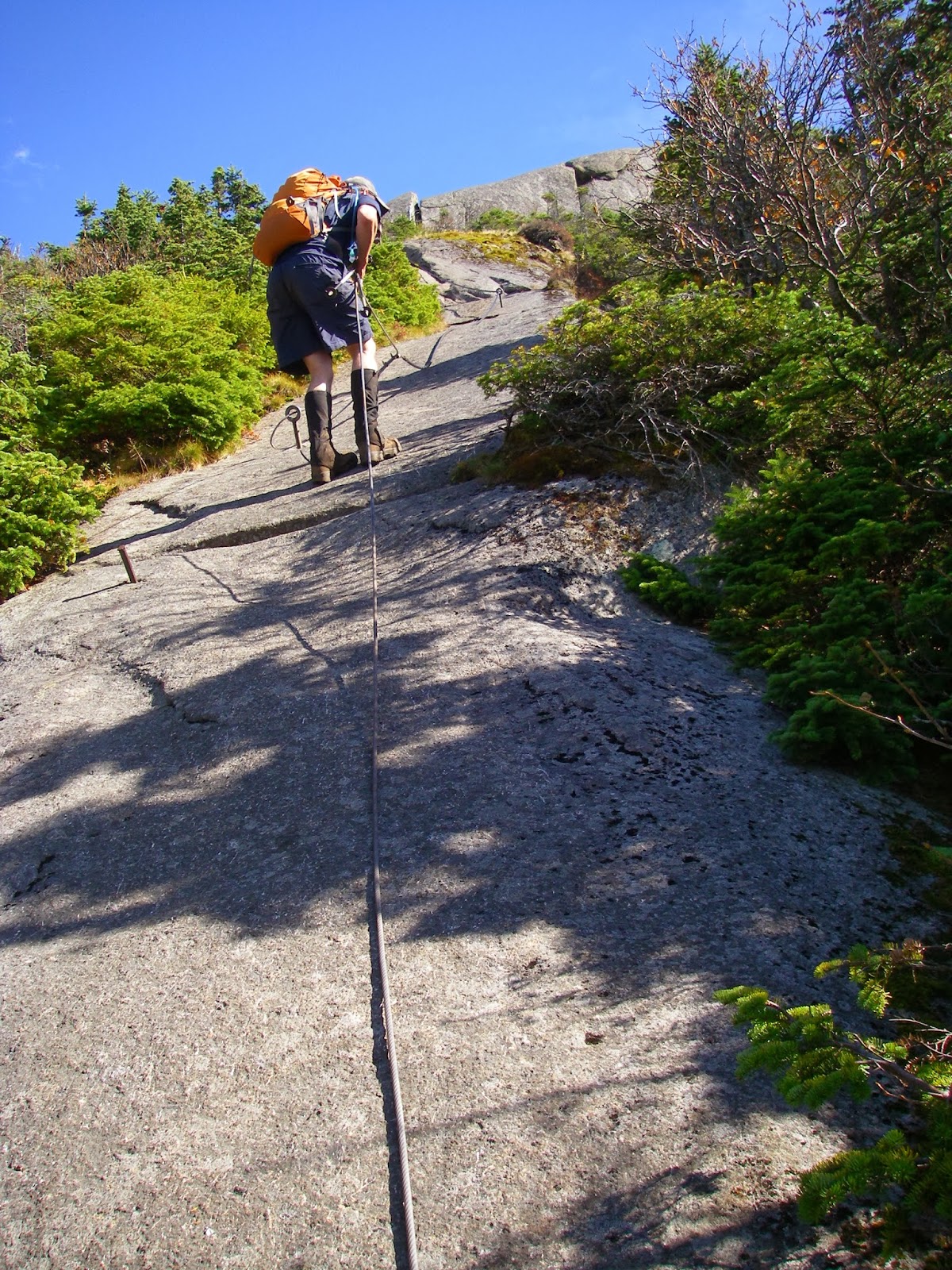
The first time I climbed Gothics, this cable was a lifesaver because the rock was icy and I had neglected to bring traction devices on the trip. This time it was under perfect conditions!

The massive hulk of Giant Mountain (left) and Rocky Peak Ridge. Vermont's Camels Hump is faintly visible between them. At center right is the rocky summit of Noonmark.

The cliffs of Gothics. Photo by Dave Socky

The beckoning path. This may also be the easiest spot on the Range Trail! We enjoyed all 100 feet of its brevity...

While tied with the hike up Allen at 19.4 miles as our longest, our toughest and most spectacular day by far was next, a traverse of most of the Great Range. We were on the trail by 5:30 a.m. for this six peak day with over 7,000 feet of total elevation gain. It was awesome to go up the new slide below the Gothics-Saddleback col - that wasn't there the first time I hiked that trail back in 1999. We did an out and back over Saddleback to Basin, and while definitely steep and certainly spectacular, neither peak was quite as vertical as I remembered. That was probably a good thing, as I had been at least a little apprehensive about going down the southwest side of Saddleback. Even so, one of us took a bit of a controlled fall at a particularly tricky spot. The real treat for me was the climb up Gothics. I did it with snow and ice, and no views the first time. Today was a bluebird day with perfect visibility. And with no ice, I was actually able to walk up the extremely steep but grippy slabs without really needing the cables. There were some burning calves though! We also made the short, but "interesting" and ever so worthwhile side trip to Pyramid. A lot of people think this is another contender for the best view in the Adirondacks. I can't say it is, but I also can't say it isn't. It is amazing by any standard. The remaining three peaks of Armstrong and the two Wolfjaws was somewhat easier than the first three peaks, but definitely still had their moments and were almost new to me, since it had been so long since I was last on them. I had hoped to go down the Bennie's Brook slide, but since we reached the top of Upper Wolfjaw just before sunset (a beautiful one at that), we decided it smart to descend on the trail instead to finish the last several miles in the dark. In fact, it was nearly 10 p.m. when we reached the car, and we had to settle for frozen pizzas bought at Stewart's and baked at the Keene Valley Hostel for dinner. The adventure of the day had been worth it though.


Great lunch spot - the summit of Rocky Peak Ridge. Photo by Dave Socky


On Bald Peak. Photo by Dave Socky
The Friday of this trip we had yet another spectacular hike planned. Though I had been on the two highest peaks once before, we had a shuttle set up so that we could do a one way traverse of Rocky Peak Ridge and Giant. A large portion of this hike is out in the open with continuous views, and many think it is one of the finest hikes in the range. We also made a new friend. I had asked about shuttle possibilities on the Adirondack High Peaks forum before the trip, and as a result, we were contacted by Kevin Sullivan, a fellow Dacks enthusiast. He was interested in joining us if we didn't mind. We didn't, and it was great hiking with him. I already have tentative plans to hike with him again around Christmas when I should be in the Catskills. Anyway, the hike was indeed great, though also somewhat mellow compared to the Great Range - at least to Rocky Peak Ridge. We had a lot of wonderful views from the open ridgeline up to that point, but by the time we made the steep descent to the col beyond and then climbed up to Giant, it had started raining lightly, and the views were much diminished, though not completely obliterated. The wet rock did make much of the descent a little tricky though. The peaks of the last two days had been repeats for me, but they had allowed Peter to catch up to me, and now we both stood at 45 peaks completed. Tomorrow, if all went as hoped, we would become Adirondack 46ers!


Yet another ladder...


...and another scramble...
...and another ladder...


...and another scramble...


...then the goal is near.


Feeling good on the summit of Sawteeth, the final peak in our rewarding quest. Photo by Peter Barr


Mission accomplished! Photo by Peter barr


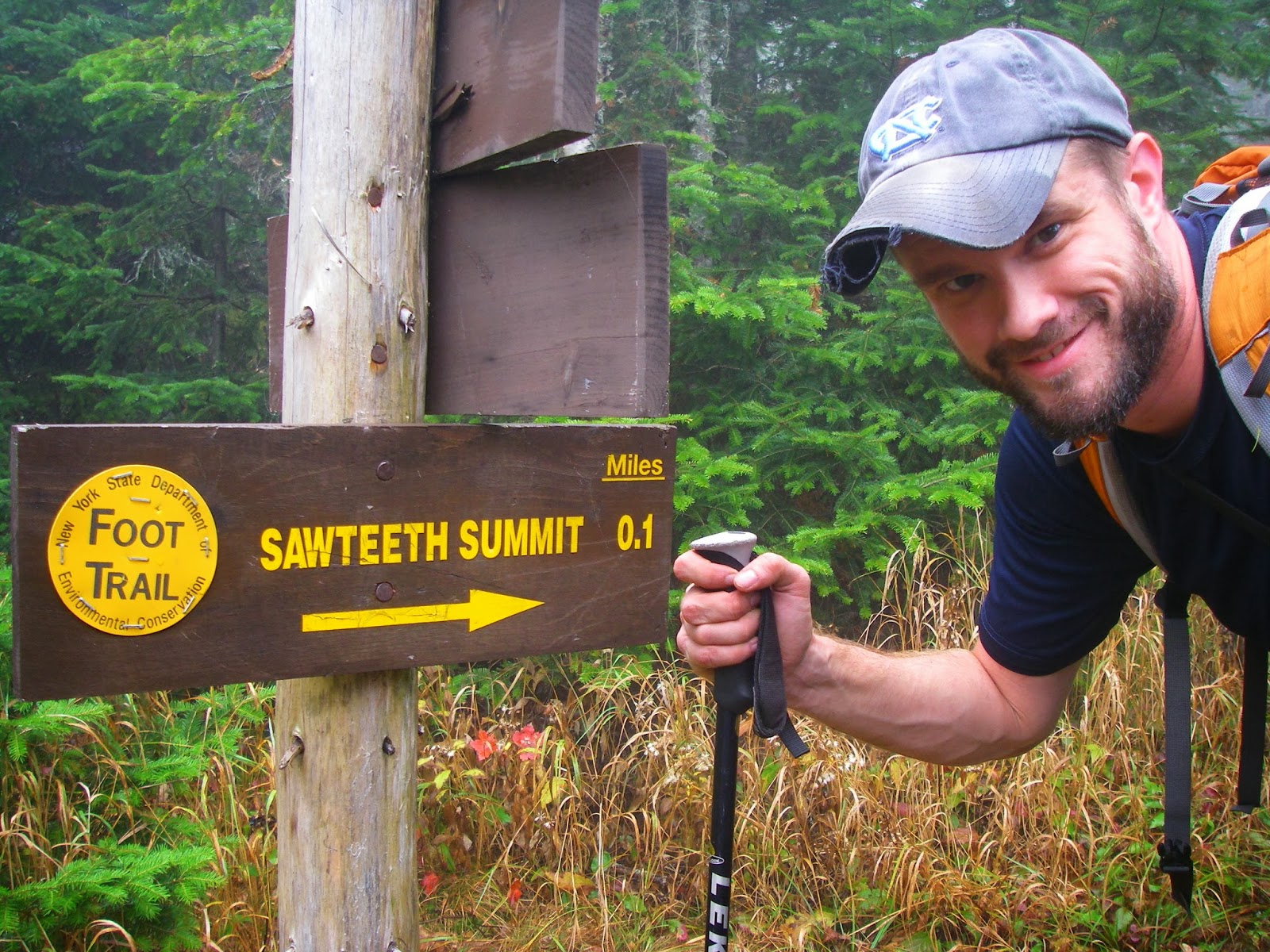
Our final peak for this long sought after quest started out with a road walk on the property of the Ausable Club. This gated gravel road actually makes for rather pleasant, fast hiking after a week of mostly rough footing and got us to the start of the loop over Sawteeth. It was another cloudy morning, but it wasn't raining so we were still excited about what we were about to do. Soon we were headed up the Scenic Trail and began encountering a series of viewpoints overlooking the fiord-like Lower Ausable Lake and the cloud-shrouded Colvin Range above it. We would have been disappointed if the going didn't get tough. We were not disappointed. The only disappointment was that we eventually walked up into the clouds. That alone could not quell our excitement when we got to the sign starting that the summit was only a tenth of a mile away. We did our best to all three step onto the summit rock at the same time, Peter and I at that moment becoming two more among the distinguished ranks of the 46ers and Dave having caught the bug.

It had been a sometimes hard, always challenging, mostly fun pursuit and the memories of it all will be with me for the rest of my life. But I am far from finished with exploring the Adirondacks and have every intention of returning many more times in the years to come. But first there are those two peaks I need in New Hampshire to complete the Northeast 115...

More pics from this trip: