Saturday, January 4, 2014

Griffith Knob and Peak 3681 - Unknown And Unnamed Isn't A Bad Thing


Griffith Knob and Peak 3681
All of the best hikes are not documented. Sometimes I think about writing a small booklet titled “The Best Unknown Hikes of Southwest Virginia”, or something similar to that, and having a listing and descriptions of local favorites, close to home but worthwhile outings, and obscure but great locales that may be either on or off trail. They might be long or short, difficult or easy, but the one thing most would have in common is that while some may be well known locally, they have been rarely or perhaps even never documented on anything other than a limited scale. Regionally well known hikes like Mount Rogers and The Cascades would not be included in this category unless they were incidental to a lesser known nearby spot, though it might be somewhat subjective on my part as to what is well known and what is not - and what is worthwhile. Most might not make it onto a list of the best hikes in the Southern Appalachians (though some could), but all would be worthwhile and of interest to someone in the area who didn’t want to drive several hours to a good place to hike, or didn’t want to be gone all day. Most of the hikes would be on public land, but if I knew that a landowner welcomed hikers, then some destinations could be on private property. Whether or not such a book ever comes to fruition, it occurred to me that I can pursue that idea in this blog from time to time. One such hike would be Peak 3681 and 3,782’ Griffith Knob in Wythe County, a half day (or less) hike little more than 20 minutes away from my home in Wytheville.

These two peaks are on Brushy Mountain, located in the northern part of the county only a few minutes from U.S. Highway 52, and are within Jefferson National Forest. Respectively, they are the seventh and fifth highest peaks in the county, and the higher Griffith Knob is also the most prominent peak in Wythe County. It should be pointed out that part of this hike is quite steep and on very faint trails, and part of it is completely off-trail, albeit in relatively open woods. As such, it is probably best done in cooler and less vegetated months. The views will also be better then. It is also easy to do only Peak 3681 for a round trip of only around two miles, though because of the route, there is little reason to not include the short side trip to the top of this one even if the primary goal is only Griffith Knob.

Mount Rogers and Whitetop from Peak 3681.
The hike begins at an unmarked pullout on FS 221 only a couple miles from Deer Trail Park. There is an obvious but unmarked path at first, perhaps made by hunters, that starts at the upper end of the parking area, and immediately begins a moderately steep 700’ climb up one of the northeastern ridges of Peak 3681 to the main crest between the two peaks but high on the shoulder of Peak 3681. The path becomes increasingly difficult to see as you climb higher, something to be well aware of for the return trip when it will be surprisingly easy to veer off onto the wrong ridge, but as long as you stay on the crest of this spur ridge going up, you will get to the right spot, hitting the main crest at about the 3,500’ elevation. Take special care to remember this exact spot. From here, turn west and continue upwards less steeply for another 3/10 mile to the top of Peak 3681. There are no wide open views here, but there are at least three spots with limited but pleasant views in different directions. From very nearly right on the summit, there is an outlook to the northwest of Walker Mountain, and peeking above its spine are the more distant and higher peaks of 4,409’ Chestnut Knob and 4,710’ Balsam Beartown, both on the rim of Burkes Garden. A few yards down the northern ridge is an outlook to the east that takes in the valley of Stony Creek between Big Walker and Little Walker Mountains. To wrap things up, one can wander perhaps 50 yards down the southern ridge and find a couple of decent sized openings in the canopy that allow some nice views of Mount Rogers and Whitetop, as well as a swath of the Iron Mountains. Again, none of these views are wide open, and they will be better when the leaves are off the trees - but they are all pretty pleasant scenes and ones that I find quite appealing.

Admiring the view of Stony Fork Valley and Little Walker Mountain from Griffith Knob.

After taking in the views, simply return back to the spot where the crest of the ridge was attained on the first leg of the hike - and again, remember it well, as it is easy to miss. At this point, you should head downhill about 1/10 mile along the southeastern ridge, losing a couple hundred feet of elevation, then regaining it to the top of the next unnamed knob at 3,640'. At this point, continue eastward on an old woods road, losing only about 50' before making a final 200' climb up Griffith Knob. It should be mentioned that the rest of the route is on the boundary between National Forest and private property, so don't please don't wander off the ridge crest to the south or east. There is no view from the top, but this is the most prominent peak in Wythe County and knowing that gives a certain satisfaction of its own if one cares about such things. Incidentally, when viewed from several miles away to the east, especially when the leaves are off and there is a bit of snow on the ground, the broad top surrounded by steep slopes and horizontal rock banding give this mountain a very “Catskillian” look that is quite impressive.

The conspicuous peak of Floyd County's Buffalo Mountain seen from Griffith Knob.


One might as well have the views too though. About ¼ mile down the north ridge, where it begins to narrow and then drop off more abruptly, there is a small clifftop opening a few yards off to the right. This is easily the best view of the hike, with an open arc of the landscape to the east and southeast. Little Walker Mountain, Queens Knob, and Sand Mountain are all in plain view and the solitary volcano-like and symmetrical form of Floyd County's Buffalo Mountain is very conspicuous to the southeast on a clear day, despite its being 44 miles away. This is a great spot to hang out for a while and enjoy what will almost certainly be complete solitude. On the return trip, hope you were paying enough attention to your route to avoid going down the wrong ridge anywhere, something that would be very easy to do in at least four different areas. A recorded track on a GPS could be much appreciated now, but it is still better if you made a mental note of key direction changes on your way here.
This hike is not going to attract crowds of people from all over the Southeast, or even the state. However, if you live within an hour or so, and are looking for something new and different, but not without some rewards, this is one of those little known hikes that can fit the bill. There are many more...


To see the topo map larger on this site, click on the map. Or click here to see it on CalTopo.


Elevation profile for this hike.

Hike stats: 4.2 miles, 1,950' cumulative elevation gain

More pics:

Resources:

Trailhead coordinates: 37.0120, -81.2283


created with Chrome OS

Sunday, December 1, 2013

Comers Rock - Earning Your Views


There are often days when I am not especially motivated to go hiking, but feel like I should get out in the woods for a few hours anyway. These same days, I usually don't want to be gone all day, nor do I want to drive very far - generally no farther than thirty minutes away. While I’m lucky enough that there are a few very nice destinations that close to home, that distance nevertheless really limits the choices, and while a lot of the hikes that close are pleasant enough, most are little more than a walk in the woods. There just aren't very many spectacular destinations really close by. Some may be nice enough otherwise, but lack appeal because there is also a road to or near the final destination. That usually takes away any feeling of remoteness out wildness, and usually makes one question why they are hiking up, when they may well encounter hordes of people who drove up. And while I myself am not averse to driving up certain peaks on occasion, it’s rarely as rewarding as a good hike to the same place.

Such is the case with Comers Rock. One can drive to within a hundred yards or so of the top, a fact that often makes me discount it as a "serious" hiking goal. But I always forget just how good views actually are from up there on a clear day, and they are even better when you earn them by hiking up. And despite the proximity of a road, there are no"hordes". Besides, it's a pleasant hike anyway, if the chosen route is through the Little Dry Run Wilderness located to the north of the mountain. For the best part of the first three miles, this trail follows the namesake creek of the Wilderness (a rather grandiose term for this little 2,858 acre parcel), a tiny little stream with gorgeous hemlock lined banks, and small pools and undercut banks that harbor native brook trout, some of the prettiest freshwater fish there are. Finding their haunts was one of the original motivations for my interest in hiking. Though I don't fish for brookies any more, I still love visiting the beautiful places they live.


Tommy Bell along Little Dry Run. While not from this particular hike, it shows how pretty the area is.
The hike starts with an unbridged crossing of Dry Run. If the creek is low enough to rockhop here, then the rest of the hike is probably not an issue. If it’s really high, you might want to come back another day. The trail follows Dry Run upstream a very short distance, then sidehills back to the North and West to reach Little Dry Run. It crosses this smaller stream numerous times, and is a bit vague in a few spots, but as long as the creek is near, so is the trail until one reaches the uppermost headwaters - and if one avoids the trailless northern tributary at the 1.4 mile mark. On another note, it was near this spot a few years ago that I turned off the trail to climb Peak 3,300, the last summit I needed to have climbed all of Wythe County's 43 ranked peaks. That adds another element to my fondness of this area. As the stream dwindles to a trickle, the trail steepens and climbs to a broad saddle to intersect the Virginia Highlands Trail. This makes an appealing return route by following it back to the highway, but the way to the top avoids it and continues straight across, onward and upward from this divide that separates Little Dry Run from Jones Creek. While it is never really steep, the remaining mile-and-a-half is decidedly uphill. Very close to the end, after all one’s work to get here, the trail disappointingly deposits one onto the gravel Forest Service road going to the same place. However, after only a hundred yards, it ends and a set of rustic stone stairs lead the remaining steps.  At least the final 150 yards is foot travel only, so there is some solace in knowing that even if you share the summit with other people, you don’t have to share it with their vehicles as well. And you know they didn’t see the pretty places you were privileged to see on the way up. As it turned out on this visit, I had the top all to myself the whole time I was here.

Brumley Mountain, Middle Knob, and Beartown on the horizon.
The summit has a couple of attributes of interest to only to peakbaggers. At 4,100’ in elevation, it is one of Virginia’s 97 ranked Four-Thousand Footers, coming in as the 62nd highest peak in the state. As it is the only peak over 4,000’ in Wythe County, is also the county highpoint for my home county. For everyone else, there are the views. The top has a few rock outcroppings, as well as a deteriorating viewing platform. Even though the railings are falling off and trees have been allowed to block the view to the West, this low platform offers quite a dramatic prospect. Starting in the Northwest and turning clockwise all the way back to the Southwest, the phalanx of mountains marching around the horizon includes a distant Brumley Mountain, Middle Knob, mighty Beartown Mountain, and White Rock on the Clinch Mountain massif. Closer in is Glade Mountain and its associated ridges as well as the sixty mile long sweep of Walker Mountain. Beyond it, to the North, are cliffbound Knob Mountain and Wynne Peak, as well as Chestnut Ridge, spruce-clad Balsam Beartown (sixth highest in Virginia, and the highest that isn’t part of the Mount Rogers massif), Garden Mountain, and East River Mountain. Most of Wythe County is in sight, and notable peaks include its most prominent peak of Griffith Knob, pointy Queens Knob, Cove Mountain, and its most isolated peak of Sand Mountain and attendant High Rocks, Lick Mountain, Stuart Mountain, Swecker Mountain, and Henley Mountain. This latter range separates the Cripple Creek and Reed Creek Valleys. Draper Mountain, Peak Knob, and High Knoll are next, while much farther to the Northeast are the high peaks of Sugar Run Mountain and Bald Knob, the latter over 50 miles away and Virginia’s most isolated peak. I can’t honestly say I have ever really looked for it, or if I have even been here on a clear enough day, but some research shows me that it should also be possible, at a bearing of 61°, and about halfway between Peak Knob and High Knoll, to see Apple Orchard Mountain from here as well. This is Virginia’s most prominent peak, and is nearly 110 miles away. If indeed it is ever visible, this would probably be one of the longest line of sight views possible in Virginia, if not the entire Southeast. It was clear on this most recent visit, but definitely not that clear. Much of the Eastern end of the Iron Mountains, of which Comers Rock itself is part of, extend as far as the New River. Things flatten out a bit on the rolling Blue Ridge Plateau to the Southeast, but a couple notable exceptions jutting up are Floyd County’s and Carroll County’s respective highpoints of Buffalo Mountain and Fisher Peak. To the south rise the considerably higher Grayson County peaks of Point Lookout and Buck Mountain, the eleventh and eighth highest mountains in the state. While not exactly in your face, the most dramatic view is probably to the Southwest. This would be the compact cluster of North Carolina mountains known as the Amphibolites. Among the rugged and spectacular peaks in view are Mount Jefferson, Phoenix Mountain, Bluff Mountain, Elk Knob, ragged Three Top Mountain, Snake Mountain, and the aptly named The Peak. Farther away are the glorious balds of the Roan Highlands. Quite an amazing collection of peaks really, but still not quite everything. By moving off the platform and onto the rocks nearby, one can look to the right of nearby Bald Rock Ridge and get a pretty good look at one of my most special places - the Grayson Highlands. Rising above First, Second, and Third Peaks are Virginia’s highest terrain. Big Pinnacle, Wilburn Ridge, and Mount Rogers are all in sight, and beckon as they always do. And by walking up, you earned the views, and can appreciate them even more. If you come in the Winter after a big snow, it might not even be possible for anyone to drive up even if they wanted to.

The eastern Iron Mountains. Floyd County's Buffalo Mountain is faintly visible near the center of the horizon.
The rugged Amphibolites of North Carolina, including Phoenix Mountain, Bluff Mountain, Elk Knob, Three Top, Snake Mountain, and The Peak.
Virginia's highest and most alluring terrain - looking towards Big Pinnacle, Wilburn Ridge, and Mount Rogers.

To see the topo map for this hike larger on this site, click on the image or click here to see it on CalTopo.


Elevation profile for this hike.

Hike stats: 9.9 miles, 2,000 cumulative elevation gain


Pictures from other visits to Comers Rock

Resources:

Trailhead Coordinates:  36.78855, -81.18327 
(trail begins across road from parking area, on West side of road)

Saturday, November 2, 2013

Bluff Mountain And Hellgate Ridge - Neglect and Rediscovery


Sometimes you realize that you shouldn't have waited so long to do a hike again. Such was my case with Bluff Mountain. I had hiked the Appalachian Trail up this mountain once before, way back in 1994. I don't really remember what I thought of it then. Maybe it was hazy, or maybe I just didn't feel like writing, because my journal from that day only makes mention that I was there. But I still knew it had a view and so it seemed like it was time to rediscover it. I've been very close to it again quite a few times during the intervening years, on a number of hikes to Rocky Row, and also to several other nearby peaks like Pinnacle.

It is a very conspicuous peak from a number of more distant viewpoints throughout the region. One reason for that is that despite its modest elevation of only 3,372', it is the most prominent peak along a 26 mile stretch of the Blue Ridge and dead center between the even more prominent, but less distinctive peaks of Apple Orchard Mountain and Rocky Mountain. It is one of only 106 mountains in Virginia to have over 1,000 feet of prominence and rises to a fairly small summit. These qualities make it stand to reason that it was once a firetower peak, and should command an extensive view. It was time to refresh my memory...

My approach the first time had been on the Appalachian Trail, but several explorations of other peaks in this area had brought a potentially interesting, and more challenging option to my attention. Assuming the Forest Service map was correct and there was public access at the start, the topo showed a pipeline and attendant service road going up Bennetts Run, then making a near beeline most of the way for the summit from the northwest. Satellite imagery seemed to confirm the same and so a plan was made. My frequent hiking companion +David was free, and up for a good hike, so off we went to explore.


Looking back at Pinnacle.
We found the gated Forest Service road and began our hike at an elevation of only 900', leaving a respectable climb to the top. The route was a bit confusing at the beginning as we skirted around a large car junkyard on private property, then tried to follow a more obscure woods road to the pipeline. We lost it in brush and briars and had to just cut through the woods to find the pipeline, only to discover it too was pretty brushy, with waist high greenery still not quite knocked down by the return of cold weather. This would not be fun in the green months but nevertheless led us up Bennetts Run, and between the peaks of Pinnacle and Target Hill (both worthy destinations themselves) to the point where the small stream split into its North and South Forks. The hiking became much more interesting at this point, as the pipeline abandoned the overgrown drainage and climbed steeply straight up the fall line of the Northwest Ridge of Bluff Mountain. The route became a rocky treadway, a narrow road really, and climbed up through open woods with some occasional views behind us of Pinnacle and Target Hill, and through the “V” they create, which allowed us to see part of the fog-laden Maury River Valley and the ridges of the Alleghenies beyond. The grade eased briefly in a couple areas, but overall it remained a fine, steep ridge that was relatively narrow and scenic. I liked it a lot!


Rocky Mountain and No Business Mountain.
Finally, at about the 2,500’ level, the pipeline veers abruptly south to drop down a few hundred feet in elevation, then climb again to the shallow gap separating Bluff Mountain and Hellgate Ridge. The ridge we were on looked more appealing than ever now, and we certainly didn’t see any reason to lose elevation, so we opted to head off-trail and continue on our current course to the top, which was now only ¾ of a mile away, albeit still over a 800 feet higher. There was a bit of scrambling, some limited views, and a bit of rhodo-whacking to round things out, but all in all it was a fine little climb. A short distance from the top, we hit the old fire tower access road and followed it the remainder of the way.


The panorama West and North from Bluff Mountain looks across the Great Valley to Big Butt, Jump Mountain, and Great North Mountain in the Alleghenies as well as toward such Blue Ridge summits as Whites Peak and Adams Peak.
Though the lookout tower that would have allowed a 360° panorama is sadly now long gone, the semi-open summit did not disappoint. Between the hardwoods and a curious handful of red spruce - usually found considerably higher or farther North, there was a great view to the south of High Peak and No Business Mountains, with the vast flattening of the Piedmont extending beyond to the limits of the horizon. But the real reward was the sweeping view of mountainous country to the North and Northeast. Close at hand were many of the low, but steep, rugged, and pointy peaks that form the western front of the Central Blue Ridge in Virginia. Among these were Elephant Mountain, Garnet Peak, Silver Peak, Whites Peak, and also Adams Peak and McClung Mountain - the last two personal favorites. To the left of all those peaks was a long swath of the Great Valley, with Buena Vista and Lexington both in sight. Beyond the valley rose the long wall of the Alleghenies, with House Mountain, Big Butt, Jump Mountain, and Elliot Knob all plainly in view along with many others. I have no intention of allowing twenty years to pass again before a third visit.

A neat pinnacle on Hellgate Ridge.
Rather than backtracking on the return hike, we followed the Appalachian Trail south a short distance, then headed off-trail again to traverse Hellgate Ridge. This was rather thick in places, but we did find a neat pinnacle on the ridgeline, as well as a small clifftop overlook with views of Silas Knob and Big Rocky Row. We also found a limited, but great view of conical Peak 2310 and impressive looking Sugarloaf Mountain.

We should have continued along the ridgeline to the top of Pinnacle for more great views and another summit for the day, but instead we dropped back down to Bennetts Run from the low spot on the ridge. This required some very steep and tedious sidehilling, and dealing with a lot of fallen trees near the creek before climbing back uphill again anyway to regain the pipeline trail. From there is was easy walking on now familiar terrain, and we found and successfully followed the faint road we had lost near the beginning of the hike. It will serve me well in the not too distant future when I do this hike again. I’m not going to neglect this great peak again now that I have rediscovered its treasures.

A minor viewpoint on Hellgate Ridge, looking toward Silas Knob and Big Rocky Row.


Route of the Bluff Mountain hike. To see a larger map click here.
Note: There seems to be a problem with the default map view I have selected not showing properly. Please select the map you prefer from the drop-down menu in the upper right hand corner of the map.

Add caption
Hike stats: 9.25 miles, 3,280' cumulative elevation gain

Pictures from this hike.

Resources:
gpx, kmz, topos for this hike

Trailhead coordinates: 37.68971, -079.39118
Google Map for trailhead


Tuesday, October 8, 2013

On Becoming An Adirondack 46er! - Part 3

On October 5, 2013, Peter Barr and I became Adirondack 46ers atop the 4,150' summit of Sawteeth

We had started planning our return for this year during the drive home last year. By the time +Peter Barr  and his wife +Allison had finished their Summer visit to the Northeast a couple months earlier, he still needed eighteen peaks to my nine, but we had agreed that it might be possible for us to both finish on this year's trip. It was ambitious, and would require everything to go just right, but it was possible and sounded like a great idea to me. I had also gotten +David Socky  interested in joining us, not because he was particularly interested in the 46ers, but because it promised to be a great trip with lots of good hikes. I was quite excited when the day of our departure finally arrived, especially when the 10 day forecast looked unbelievably good.

Halfway! Dave's 25th state highpoint.

Hitting the road around 5 a.m., we drove pretty much nonstop except for gas, and made it to Port Jervis, NY early enough that I suggested we make a quick drive up to the nearby New Jersey state highpoint so that Dave could add it to his growing list of completions. Accurately, but unimaginatively named High Point, this 1,803’ foot mountain was Dave’s 25th state high point, and along with a scale replica of the Washington Monument on its summit, on a clear day it actually has surprisingly good views of the Kitattiny Ridge, Hudson Highlands, and Shawangunks, as well as the higher and more distant Catskills. We did not linger long, as we had hopes of doing a short hike in the Southern Adirondacks before dark. I had tried to fit Crane Mountain into other trips before, but it had never quite worked out. This time it did. We got to the trailhead with, as it turned out, just enough time to do a great four mile loop to the cliffy summit of this classic hike and start the trip off right. The rest of the week would be spent climbing Adirondack 46ers.


Peter on Crane Mountain. Photo by Dave Socky

Dave crossing the Hudson River.
We decided to start the remainder of the week off by "eating the frog first" and doing what would probably be two of the hardest hikes of the trip on the first two days. The pick for Day One ended up being Allen Mountain, a peak that doesn't have a reputation for being the most spectacular in the Dacks, but does have the distinction of being one of the most remote, as well as requiring possibly the longest hike to get a single peak, a near twenty miler. One can normally bag several Adirondack peaks on a hike of this length. It has the additional difficulties of two river crossings, several normally boggy areas, and the notoriously slick "red slime" on the wet rocks of the mountain proper. Much to our pleasure, we had a comparatively easy day, a theme that would be true all week thanks to dry weather. The crossings of both the Hudson and the Opalescent Rivers were relatively easy rockhops, and there was little in the way of mud and boggy areas. We did still have the algae slickened rocks and steepness of the actual climb of the peak to deal with though, so it wasn't a “gimme” by any means, and we still barely managed to finish by dark, therefore having no chance of also tacking on a side trip up Mount Adams. That firetower peak will have to wait for another time, but it had turned out that Allen had surprisingly good views of its own, particularly toward the Great Range. Sawteeth, the peak we hoped to finish the 46ers on later in the week was in plain sight too, which was pretty neat.

Sawteeth (right center) would be my and Peter's final ADK 46er peak at the end of the week. Our ascent route would follow the Scenic Trail across the "sawteeth" of the right ridgeline.

I stepped in an Adirondack booby trap on the way back from Allen.

The next morning we were on the trail shortly after it got light and soon enough we were heading up Santanoni Brook. Once we got onto the herd path at Bradley Pond, things were straight up as usual and we began the root grabbing, rock scrambling ascent to Times Square, thence to the summit of Panther Peak and its excellent views. Of course, there was also a perhaps too good view of the little bundle of joy that we were heading for next. That would be 3,792' Couchsachraga, "affectionately" known as "Cooch". Since this peak actually misses being a 4,000 Footer by over two hundred feet - and isn't even a ranked peak, I think most people are annoyed by the fact that it remains on the list. It would probably elicit less animosity if it were easy, but the simple fact of the matter is that it requires a side trip of three miles, losing and gaining several hundred feet of elevation, part of it steeply, and crossing a notorious bog in the col between it and Panther. Oh yeah - it doesn't even have a view. It turned out that the hike was actually kind of fun though, and the bog wasn't that big of an obstacle - no doubt thanks to the dry weather. A couple of older gentlemen we had passed just before the bog however, had told Dave that "I wouldn't want to be you" when they saw that he didn't have trekking poles to use for balance while crossing all the small limbs and branches that past hikers have laid out across the bog. This funny remark ended up being oft repeated the rest of the week whenever the going got really challenging, because the upper part of this"trail" is probably nearly as difficult as anything else I have ever done in the Adirondacks. 

Eyeing the long side trip to 'Coochie. While we were NOT looking forward to doing that peak, it turned out to be less difficult than anticipated.


Dave descending the extremely steep and aptly named upper section of the Santanoni Express. In a classic case of downplaying the difficulty, another hiker had very casually told us "it's not bad".

The Sawtooth Mountains and the distant pyramid of Whiteface. Photo by Dave Socky

Monday's hike was somewhat easier, a single peak trek up Seymour. This ended up being quite enjoyable, with several miles of easy walking on the relatively flat and smooth Ward Brook Truck Trail. There was also a nice display of Fall foliage all along this first part of the hike, with lots of reds and oranges. I would say that the colors were pretty much at peak here. The hike up the actual mountain was just a typical bout of going straight up, complete with occasional sections of Adirondack problem solving. Just before topping out, we got waylaid by a large outcropping just off the trail known as"See-more" Rock. The views from here were nothing less than spectacular. The summit would just have to wait because we decided to take a long lunch and picture break at this unexpectedly wonderful lookout with a sweeping view that included Seward, Ampersand, the Sawtooths, Whiteface, and a large swath of the North Country beyond. It was a few more minutes to the top, and as usual, there was still a bit more work to do than expected to get there. I had a prophetic fortune at the Chinese buffet in Saranac Lake afterwards. It said: "Your aspirations are met with success soon." I decided to keep that one.


Trail through the krumholz on Colden. Photo by Dave Socky

On Bob's namesake peak - Mount Marshall. Photo by Dave Socky

On the herd path for Cliff Mountain, another typical obstacle in the Dacks, where easy hiking is a rarity - but it's never boring! 
Even the valley trails are slow going at times. In Avalanche Pass.

We had mistakenly assumed the second day of this hike would be relatively easy. It was not. We headed up the Opalescent River to the herd path for Redfield and Cliff, thence continued climbing along Uphill Brook. Actually, Redfield wasn't unusually difficult, it just seemed longer than I was expecting. This was our first viewless peak, as we found ourselves well up into the clouds this morning. At least it wasn't raining though. Cliff turned out to be appropriately named and was considerably more difficult than I was anticipating based on its modest length and elevation gain. A lot of that gain was rather precipitous and involved a good bit of challenging, but fun scrambling up rock faces. It was also a bit more of a drop into the col between the false and true summits than I expected from a cursory glance at the map. We were still in the clouds on this one too, so we did not linger. Where we did linger for a while was at the rather spectacular spot on the Opalescent River where a decent sized waterfall plunged into a narrow slot canyon-like defile. After returning to the leanto and gathering our gear, we began the hike back out as the skies cleared. This made for a great walk through the always amazing Avalanche Pass area and its rocky ruggedness.

On top of Basin Mountain. Haystack, Skylight, and Marcy in the distance. Photo by Peter Barr

Slight exposure on Saddleback.

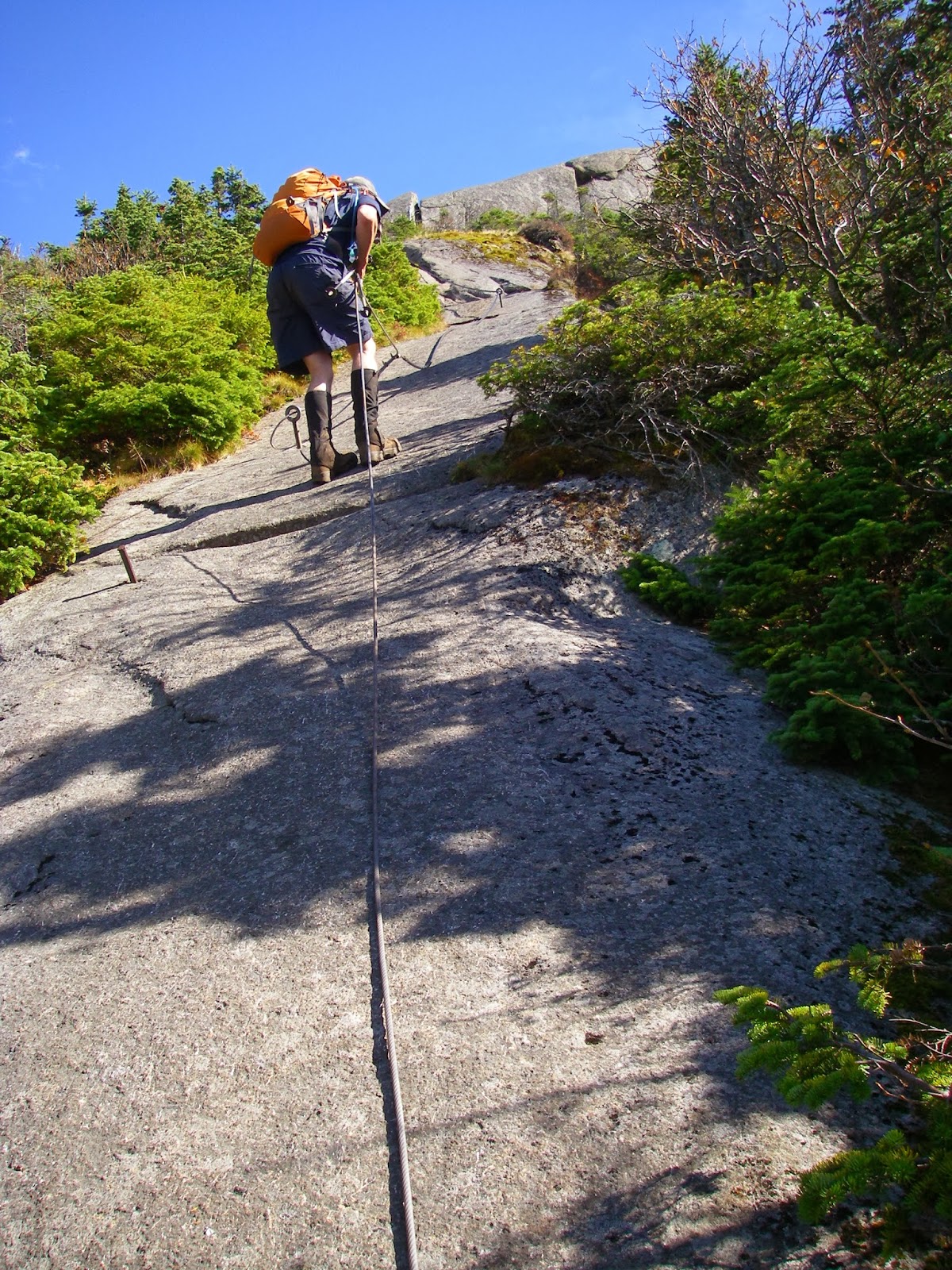
The first time I climbed Gothics, this cable was a lifesaver because the rock was icy and I had neglected to bring traction devices on the trip. This time it was under perfect conditions!

The massive hulk of Giant Mountain (left) and Rocky Peak Ridge. Vermont's Camels Hump is faintly visible between them. At center right is the rocky summit of Noonmark.

The cliffs of Gothics. Photo by Dave Socky

The beckoning path. This may also be the easiest spot on the Range Trail! We enjoyed all 100 feet of its brevity...

While tied with the hike up Allen at 19.4 miles as our longest, our toughest and most spectacular day by far was next, a traverse of most of the Great Range. We were on the trail by 5:30 a.m. for this six peak day with over 7,000 feet of total elevation gain. It was awesome to go up the new slide below the Gothics-Saddleback col - that wasn't there the first time I hiked that trail back in 1999. We did an out and back over Saddleback to Basin, and while definitely steep and certainly spectacular, neither peak was quite as vertical as I remembered. That was probably a good thing, as I had been at least a little apprehensive about going down the southwest side of Saddleback. Even so, one of us took a bit of a controlled fall at a particularly tricky spot. The real treat for me was the climb up Gothics. I did it with snow and ice, and no views the first time. Today was a bluebird day with perfect visibility. And with no ice, I was actually able to walk up the extremely steep but grippy slabs without really needing the cables. There were some burning calves though! We also made the short, but "interesting" and ever so worthwhile side trip to Pyramid. A lot of people think this is another contender for the best view in the Adirondacks. I can't say it is, but I also can't say it isn't. It is amazing by any standard. The remaining three peaks of Armstrong and the two Wolfjaws was somewhat easier than the first three peaks, but definitely still had their moments and were almost new to me, since it had been so long since I was last on them. I had hoped to go down the Bennie's Brook slide, but since we reached the top of Upper Wolfjaw just before sunset (a beautiful one at that), we decided it smart to descend on the trail instead to finish the last several miles in the dark. In fact, it was nearly 10 p.m. when we reached the car, and we had to settle for frozen pizzas bought at Stewart's and baked at the Keene Valley Hostel for dinner. The adventure of the day had been worth it though.


Great lunch spot - the summit of Rocky Peak Ridge. Photo by Dave Socky


On Bald Peak. Photo by Dave Socky
The Friday of this trip we had yet another spectacular hike planned. Though I had been on the two highest peaks once before, we had a shuttle set up so that we could do a one way traverse of Rocky Peak Ridge and Giant. A large portion of this hike is out in the open with continuous views, and many think it is one of the finest hikes in the range. We also made a new friend. I had asked about shuttle possibilities on the Adirondack High Peaks forum before the trip, and as a result, we were contacted by Kevin Sullivan, a fellow Dacks enthusiast. He was interested in joining us if we didn't mind. We didn't, and it was great hiking with him. I already have tentative plans to hike with him again around Christmas when I should be in the Catskills. Anyway, the hike was indeed great, though also somewhat mellow compared to the Great Range - at least to Rocky Peak Ridge. We had a lot of wonderful views from the open ridgeline up to that point, but by the time we made the steep descent to the col beyond and then climbed up to Giant, it had started raining lightly, and the views were much diminished, though not completely obliterated. The wet rock did make much of the descent a little tricky though. The peaks of the last two days had been repeats for me, but they had allowed Peter to catch up to me, and now we both stood at 45 peaks completed. Tomorrow, if all went as hoped, we would become Adirondack 46ers!


Yet another ladder...


...and another scramble...
...and another ladder...


...and another scramble...


...then the goal is near.


Feeling good on the summit of Sawteeth, the final peak in our rewarding quest. Photo by Peter Barr


Mission accomplished! Photo by Peter barr


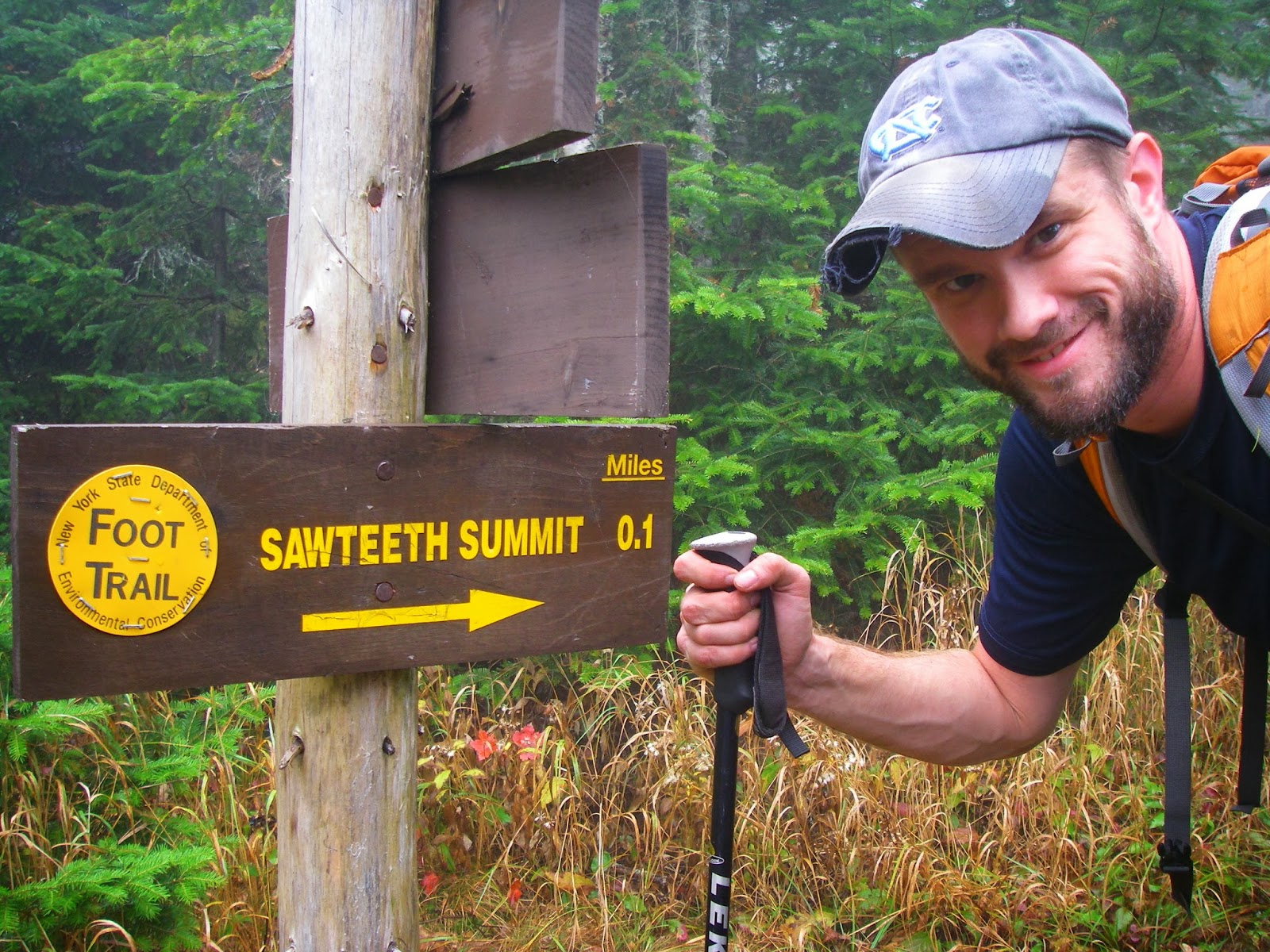
Our final peak for this long sought after quest started out with a road walk on the property of the Ausable Club. This gated gravel road actually makes for rather pleasant, fast hiking after a week of mostly rough footing and got us to the start of the loop over Sawteeth. It was another cloudy morning, but it wasn't raining so we were still excited about what we were about to do. Soon we were headed up the Scenic Trail and began encountering a series of viewpoints overlooking the fiord-like Lower Ausable Lake and the cloud-shrouded Colvin Range above it. We would have been disappointed if the going didn't get tough. We were not disappointed. The only disappointment was that we eventually walked up into the clouds. That alone could not quell our excitement when we got to the sign starting that the summit was only a tenth of a mile away. We did our best to all three step onto the summit rock at the same time, Peter and I at that moment becoming two more among the distinguished ranks of the 46ers and Dave having caught the bug.

It had been a sometimes hard, always challenging, mostly fun pursuit and the memories of it all will be with me for the rest of my life. But I am far from finished with exploring the Adirondacks and have every intention of returning many more times in the years to come. But first there are those two peaks I need in New Hampshire to complete the Northeast 115...

More pics from this trip: